
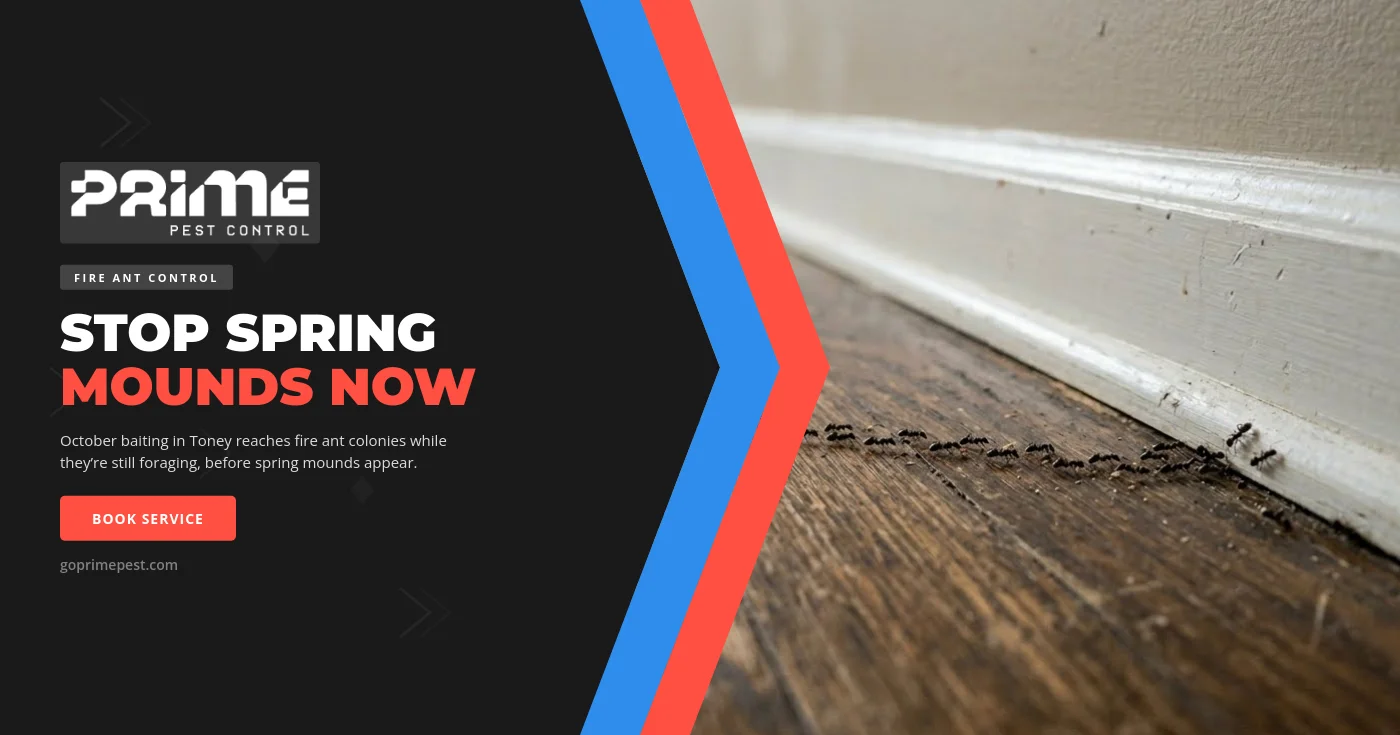
Every spring it seems to happen overnight. A few days of steady rain roll through, and suddenly the front yard, the garden edge and the back pasture are dotted with fresh, fluffy fire ant mounds. Most people grab a shaker can and start treating mounds one by one. The problem is that by then, the colonies have already won. That’s why we recommend fall fire ant treatment in Toney, AL every October. Baiting while colonies are still foraging reaches them long before next spring’s mounds show up.
North Alabama fire ants don’t care whether you have a quarter-acre subdivision lot or forty acres of hay and cattle pasture. They sting kids and pets, swarm boots, dull mower blades and build mounds that turn a hay field into a headache. Across Madison and Limestone counties, the colonies you’ll fight in April are already living under your grass right now.
In this post, we’ll cover why fire ants stay busy into October, what colonies do to get ready for winter, why a fall fire ant bait treatment outperforms waiting for spring, how to spot activity on lawns and acreage, why kicking or drenching mounds usually backfires and how our professional process works. We’ll finish with answers to the questions we hear most.
It’s easy to assume fire ants slow down once the leaves start to turn. In reality, early to mid fall is one of their busiest stretches. According to the Alabama Cooperative Extension System, fire ant baits work best when ants are actively foraging, which generally means temperatures between 70 and 95 degrees Fahrenheit, and not right before or after rain.
In a typical year, October afternoons in our part of North Alabama land right in that range, with highs often in the 70s. That makes early and mid October a sweet spot: warm enough for workers to be out hunting for food, but past the brutal late-summer heat that pushes foraging into the early morning and evening.
Fall also tends to bring more dry stretches than spring, though that varies from year to year. Fewer rainy days mean more chances to put bait down and have it picked up before weather moves in. Late October cold fronts, on the other hand, can drop temperatures below 70 degrees for days at a time, and foraging slows sharply when that happens. That’s why we tell customers not to wait until November.
One more detail matters: ACES notes that fire ants will travel as far as necessary to find food. Even if you can’t see a mound near your patio, workers from a colony under the neighbor’s fence line may be crossing your lawn every afternoon. A broadcast bait reaches them where they forage.
Fire ants don’t migrate, and in most winters they don’t die off in North Alabama either. Instead, colonies spend fall stocking up. Workers forage heavily, carrying food back to the queen and the developing brood so the colony enters the cold months strong.
As soil temperatures drop, colonies generally retreat deeper into the ground, where it stays warmer. By December, mounds may look flat, crusted over or abandoned, but the colony is usually still down there. A hard freeze might knock back some workers, but it rarely reaches the queen. Once spring rains soak the soil, the colony pushes back up and rebuilds, often in a new spot.
Mating flights through spring and summer leave behind newly mated queens that start fresh colonies. Many of these young colonies haven’t built a visible mound by fall. They’re small, hidden in the turf and easy to miss. If you only treat the mounds you can see, these colonies survive the winter and become next spring’s “new” mounds.
Much of North Alabama is also home to hybrid imported fire ants, a cross between red and black imported fire ants. Extension sources generally describe them as behaving much like their parent species, so the same timing principles should apply.
A fire ant bait treatment works because worker ants pick up the bait and carry it home, sharing it through the colony until it reaches the queen. When the queen dies, the colony collapses. Bait only works when ants are hungry and foraging, and October is when they’re doing exactly that.
ACES puts it plainly: broadcasting a fire ant bait at the right time manages the mature colonies as well as the young colonies that have yet to construct a visible mound. That second group is the whole reason fall baiting pays off. Waiting for spring mounds means you’re only reacting to colonies that already made it through winter.
Spring baiting still has a place, but ACES notes that extension professionals typically don’t recommend it any earlier than April, and spring weather is unpredictable. Rainy weeks interrupt foraging and can spoil bait before ants find it. ACES names spring and fall as the best windows and says a second application can go out in September or October.
Bait isn’t instant. Based on general extension guidance and our own experience, it can take several weeks, sometimes longer, for a colony to fully decline. An early or mid October application gives the bait time to work while ants are still active, instead of racing a cold front. The result is fewer colonies heading into winter and noticeably fewer fire ant mounds in lawn areas once spring arrives.
Fall mounds are often less obvious than spring ones, so it helps to know what to look for.
Fire ants love sunny, open turf, so the middle of a well-kept lawn is fair game.
On larger properties, mounds can number in the dozens per acre. Watch fence lines, water troughs, feeders and hay fields, where mounds can damage equipment and slow cutting. Livestock and horses may avoid heavily infested areas.
ACES notes that broadcast baits are the easiest and most economical option for larger areas because there’s no need to locate individual mounds. Keep in mind that whether a product can be used where animals graze, or on land cut for hay, depends entirely on the product label. We match the product to how your land is used.
While you’re walking those fence lines, watch for ticks too. The tall grass and wooded edges that hold fire ants often hold ticks, and our tick control service pairs well with a fall visit.
When a mound pops up next to the swing set, the instinct is to kick it flat, pour something on it and be done. Unfortunately, these quick fixes rarely reach the queen.
Even store-bought bait has a catch. ACES explains that baits rely on an attractant oil that goes bad if kept too long or stored improperly, and an opened bag should be used right away. A half-used bag sitting in a hot garage since last year may not attract ants at all. Baits also stay effective for only a short time after they’re spread, so applying on a cool, wet day can waste the whole effort. Timing, fresh product and even coverage make all the difference.
Here at Prime Pest Control, we build our fall service around the same principles extension specialists recommend, then bring the experience to apply them well.
We start by walking your property, noting active mounds, problem zones and how the land is used: play areas, gardens, pasture or hay. We also confirm the ants are actually foraging. ACES suggests a simple test: set out a potato chip or cracker, and if ants find it quickly, conditions are right for baiting. If not, we wait for a better day.
Next, we broadcast fresh bait evenly across the treatment area, not just on mounds, so foraging workers from every colony, visible or not, carry it home. ACES notes many baits are applied at about 1 to 1.5 pounds per acre, but we always follow the product label for rate, placement and any grazing or re-entry directions.
For mounds in high-traffic spots, such as beside a back door or a playset, we may add a targeted treatment for faster relief while the bait works through the rest of the yard.
We’ll check results and talk through whether a spring follow-up makes sense. If other pests are moving indoors as the weather cools, our general pest control service can cover those too.
No. In most years, early and mid October is ideal because afternoon temperatures usually sit in the range where ants forage. The window starts to close once late-October cold fronts hold temperatures below 70 degrees, so earlier in the month is better.
Expect gradual results. Depending on the product and weather, it can take several weeks or more for colonies to decline, because workers have to carry the bait to the queen first.
Rain can ruin bait before ants collect it, which is why ACES advises against applying right before or after rain. We watch the forecast and schedule around wet weather.
The label is the rule. We follow every label direction, explain how long to keep kids and pets off treated areas and choose products labeled for pasture or hay ground when animals are involved, so you have peace of mind.
Often, yes. Fire ants move in from neighboring properties, and new queens arrive every year. A fall treatment followed by a spring check, no earlier than April, keeps pressure low.
The mounds you’ll be fighting next April are already growing beneath your grass today. Baiting while colonies are still foraging gives the bait time to reach the queen before winter, which means fewer mounds, fewer stings and a yard you can enjoy come spring.
Here at Prime Pest Control, we provide fire ant control Toney families and landowners can count on, and we serve Huntsville, Madison, Harvest, Meridianville, Hazel Green, Hampton Cove and communities across North Alabama. Whether you need an ant exterminator Toney AL neighbors recommend for a subdivision lot or a broadcast plan for pasture and hay ground, we’ll tailor fall fire ant treatment to your property. Contact Prime Pest Control to schedule your visit before the cold fronts arrive.
We get this question every year, and our answer usually surprises people: fall, ideally early to mid October. Here at Prime Pest Control, we time fire ant baiting for when colonies are still actively foraging, because that’s when worker ants pick up bait and carry it back to the queen.
Waiting for new mounds after spring rains means you’re only reacting to colonies that already made it through winter. A fall broadcast treatment reaches both mature colonies and young ones that haven’t built a visible mound yet, so you see fewer mounds when the weather warms up.
Our fall fire ant service includes:
We follow every product label, including any grazing or re-entry directions, so you have peace of mind around kids, pets and livestock. We also schedule around rain, since wet weather can spoil bait before ants ever find it.
Want the full breakdown on why October works so well? Read our post, Fall Fire Ant Treatment in Toney, AL: Why October Is the Best Time to Stop Next Spring’s Mounds, or visit our ant control page to get started.