
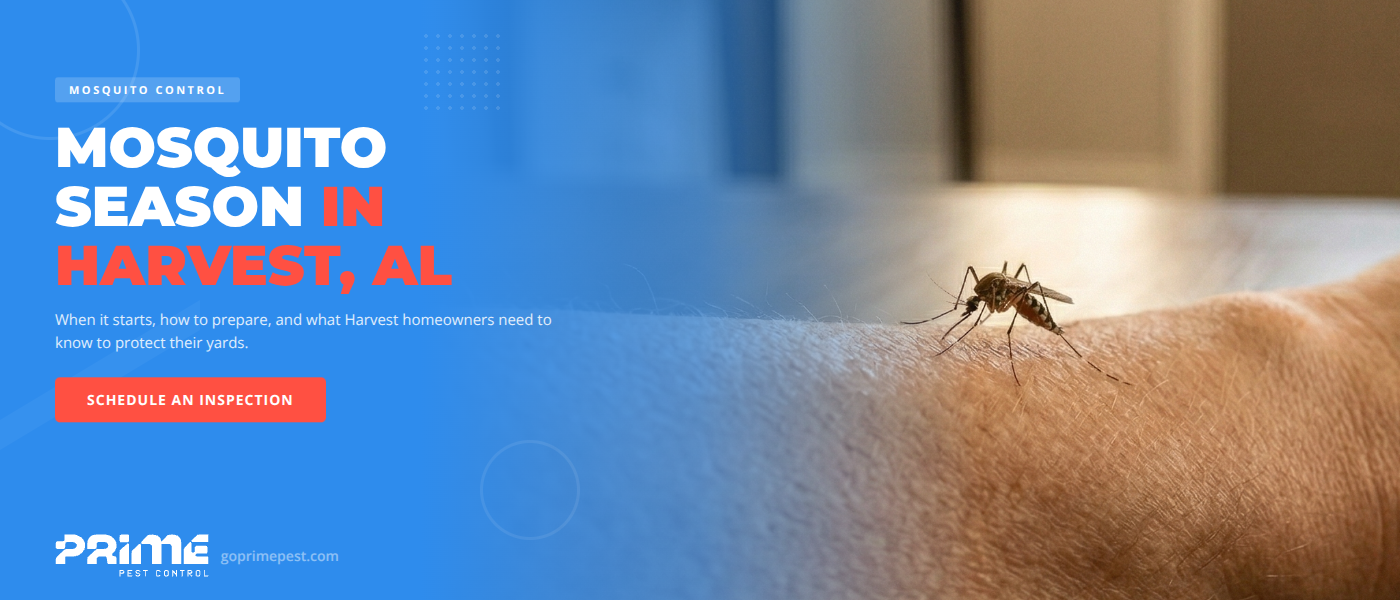
If you live in Harvest, AL, you already know that warm, humid Alabama weather brings more than just beautiful green landscapes. It also brings mosquitoes. Every year, homeowners across the Tennessee Valley ask us the same question: when does mosquito season actually start? Understanding the timing of mosquito activity in Harvest, AL is the first step toward protecting your family and enjoying your outdoor spaces all spring and summer long.
At Prime Pest Control, we help families throughout the Harvest and greater Huntsville area prepare for mosquito season before these biting pests take over backyards, patios, and porches. In this guide, we will walk you through everything you need to know about mosquito season timing, what drives mosquito populations in North Alabama, and the most effective strategies for keeping your property protected.
Mosquito season in Harvest, AL typically begins in early to mid-March, though the exact start date varies from year to year based on weather conditions. The key trigger is temperature. Mosquitoes become active when outdoor temperatures consistently stay above 50 degrees Fahrenheit. In northern Alabama, this threshold is usually reached sometime in March, a few weeks later than along the Gulf Coast where warmer temperatures arrive sooner.
By April, mosquito populations in Harvest are well established and growing. Female mosquitoes begin laying eggs in any available standing water, and the warm spring rains that are common across Madison County provide the perfect breeding conditions. Each female mosquito can lay up to 200 eggs at a time, and those eggs can hatch in as little as 48 hours when conditions are right.
The bottom line is that if you wait until you start getting bitten to think about mosquito control, you are already behind. We recommend starting preventive treatments in early March to get ahead of the first generation of mosquitoes emerging from their winter dormancy.
While mosquito season begins in March, peak activity in Harvest, AL runs from June through September. During these months, the combination of high temperatures, elevated humidity, and frequent afternoon thunderstorms creates ideal conditions for explosive mosquito population growth. Alabama is home to roughly 60 different mosquito species, and many of them thrive in the warm, moist environment found throughout the Tennessee Valley.
During peak season, you will notice mosquitoes are most active during two windows of the day:
Some species, particularly the Asian tiger mosquito which is common in Alabama, are aggressive daytime biters. This means you may encounter mosquitoes throughout the entire day, especially in shaded areas of your yard near dense vegetation or standing water sources.
Harvest sits in the heart of Madison County, an area characterized by rolling terrain, agricultural land, and residential neighborhoods with mature landscaping. Several factors make our community particularly attractive to mosquitoes:
One of the most important things we tell our customers is that mosquitoes do not need much water to breed. A space as small as a bottle cap filled with water is enough for mosquitoes to lay eggs and produce a new generation of biting adults. Here are the most common breeding sites we find during property inspections in Harvest:
Mosquitoes are more than just a nuisance. They are vectors for several serious diseases that have been documented in Alabama. The Alabama Department of Public Health actively monitors for mosquito-borne illnesses throughout the state, and residents in Harvest and the greater Huntsville area should be aware of the following risks:
Protecting your family from these diseases starts with reducing mosquito populations on and around your property. Professional mosquito control treatments create a barrier that dramatically reduces the number of mosquitoes in your outdoor living areas.
We take a comprehensive approach to mosquito control that combines professional-grade treatments with practical prevention advice. Here is what we recommend for Harvest homeowners who want to enjoy their yards without constant swatting and itching:
Our mosquito control program targets the areas where mosquitoes rest and breed on your property. We apply treatments to vegetation, shaded areas, fence lines, and the perimeter of your home. These treatments eliminate existing adult mosquitoes on contact and provide residual protection that continues working for weeks.
For properties with water features, ponds, or drainage areas that cannot be completely eliminated, we use targeted larvicide treatments that prevent mosquito larvae from developing into biting adults. These products are eco-friendly and will not harm fish, birds, or other wildlife.
During every service visit, our technicians conduct a thorough inspection of your property to identify and address mosquito breeding sites. We provide recommendations for eliminating standing water sources and improving drainage to reduce mosquito habitat.
Mosquito populations fluctuate throughout the season based on weather conditions. We adjust our treatment schedule and approach based on current mosquito activity levels in the Harvest area to ensure consistent protection from March through October.
While professional mosquito treatments are the most effective way to control mosquito populations, there are several steps you can take between service visits to keep mosquito numbers down around your Harvest home:
We recommend beginning professional mosquito treatments in early March, before mosquitoes become fully active. Starting early allows us to target the first generation of emerging adults and prevent population growth before it accelerates. Waiting until peak season means playing catch-up against an established mosquito population.
Mosquito season in the Harvest and Huntsville area typically runs from early March through late October or early November. Peak activity occurs from June through September. A hard freeze in late fall finally brings mosquito season to an end, though the exact timing varies each year depending on when the first sustained cold weather arrives.
Yes. The products we use for mosquito control are specifically selected to be effective against mosquitoes while remaining family-friendly and pet-friendly. We recommend staying off treated surfaces until they dry, which typically takes about 30 minutes. After that, your family and pets can resume normal outdoor activities.
While it is impossible to achieve 100 percent elimination since mosquitoes can fly in from neighboring properties, professional barrier treatments typically reduce mosquito populations on a treated property by 85 to 90 percent. Combined with source reduction efforts, most of our Harvest customers report a dramatic improvement in their ability to enjoy their outdoor spaces.
Research has shown that mosquitoes are attracted to carbon dioxide, body heat, certain skin bacteria, and specific chemical compounds in sweat. People who exercise outdoors, have higher body temperatures, or produce more carbon dioxide tend to attract more mosquitoes. Blood type may also play a role, with some studies suggesting that Type O blood may be more attractive to certain mosquito species.
Do not let mosquitoes take over your backyard this year. The best time to start mosquito control is before the season hits full swing. Whether you are dealing with an existing mosquito problem or want to prevent one from developing, our team is ready to help you reclaim your outdoor living spaces.
Ready to enjoy a mosquito-free yard this season? Contact us today to schedule your first mosquito treatment and take back your backyard before peak season arrives.