
If you have spent an early-September afternoon in your backyard in Southeast Huntsville, you may have noticed something has shifted. The yellow jackets that felt like background noise in June are now dive-bombing your soda can and stinging with almost no warning. The change is real, it is biological, and effective wasp control Southeast Huntsville AL homeowners rely on this time of year means paying attention to nests before the colony reaches its most volatile phase.
At Prime Pest Control, we handle wasp control across Southeast Huntsville, Hampton Cove, and Owens Cross Roads every week from mid-summer through the first killing frost. Below is why September is the most dangerous month for yellow jackets in North Alabama, how to spot an active nest, and how our team clears colonies without making a bad situation worse.
Why September Is the Most Dangerous Month for Yellow Jackets in Southeast Huntsville
Yellow jacket colonies in Southeast Huntsville start every spring from a single overwintered queen. She lays a first brood in a hidden cavity — often an abandoned rodent burrow — and by June the colony has a few hundred workers. Through July and August the workers build the nest out. By early September, a typical mature colony in the Huntsville region contains between two and five thousand adult workers.
Population peak is only half the story. The other half is food. Through summer, workers feed themselves on sugars from ripe fruit and tree sap while carrying protein back to the larvae. By early September the larvae are largely done being fed, natural sugar sources dry up, and the workers suddenly need calories with nowhere obvious to get them.
That is when they discover your patio. According to the Alabama Cooperative Extension System, "the end of summer and fall are peak yellow jacket season in Alabama," and yellow jackets "can also become more aggressive in the fall, as the colony starts to die out." A worker that ignored you in June will now defend a sugary drink or an open trash can as if it were the nest itself. This combination — peak worker count and food-driven aggression — is why professional wasp control Southeast Huntsville AL households request most often falls in the first three weeks of September.
How to Identify an Active Wasp or Yellow Jacket Nest Near Your Home
Most Southeast Huntsville families never see the actual nest — they see the traffic. Quiet observation from a comfortable distance almost always reveals the entrance, and knowing what to look for makes yellow jacket removal Huntsville AL homeowners request far more targeted.
The Alabama Extension article describes the giveaway flight well: yellow jackets fly in a "unique rapid, side-to-side pattern prior to landing." If you stand still for two or three minutes and watch for that zigzag arrival, you can usually triangulate the nest opening. On our Southeast Huntsville inspections we most often find nests in the following locations:
- Ground burrows in shaded landscaping. Abandoned chipmunk or rodent tunnels along a mulch bed, in pine straw, or at the base of a landscape timber. The opening is smaller than a quarter and easy to miss until a mower passes over it.
- Under decks, porches, and steps. The dark cavity beneath a wooden deck is nearly ideal — sheltered, insulated, and rarely disturbed.
- Wall voids and soffit gaps. A dime-sized gap in a soffit becomes an entry point to an insulated attic cavity. The nest may be entirely inside the wall while workers stream in and out of the exterior opening.
- Attic vents and gable ends. Ridge vents, dryer vents, and gable louvers all offer sheltered space for a large colony.
- Utility boxes, retaining walls, and stone piers. The hollow behind a loose block or inside a decorative retaining wall regularly holds mature ground colonies.
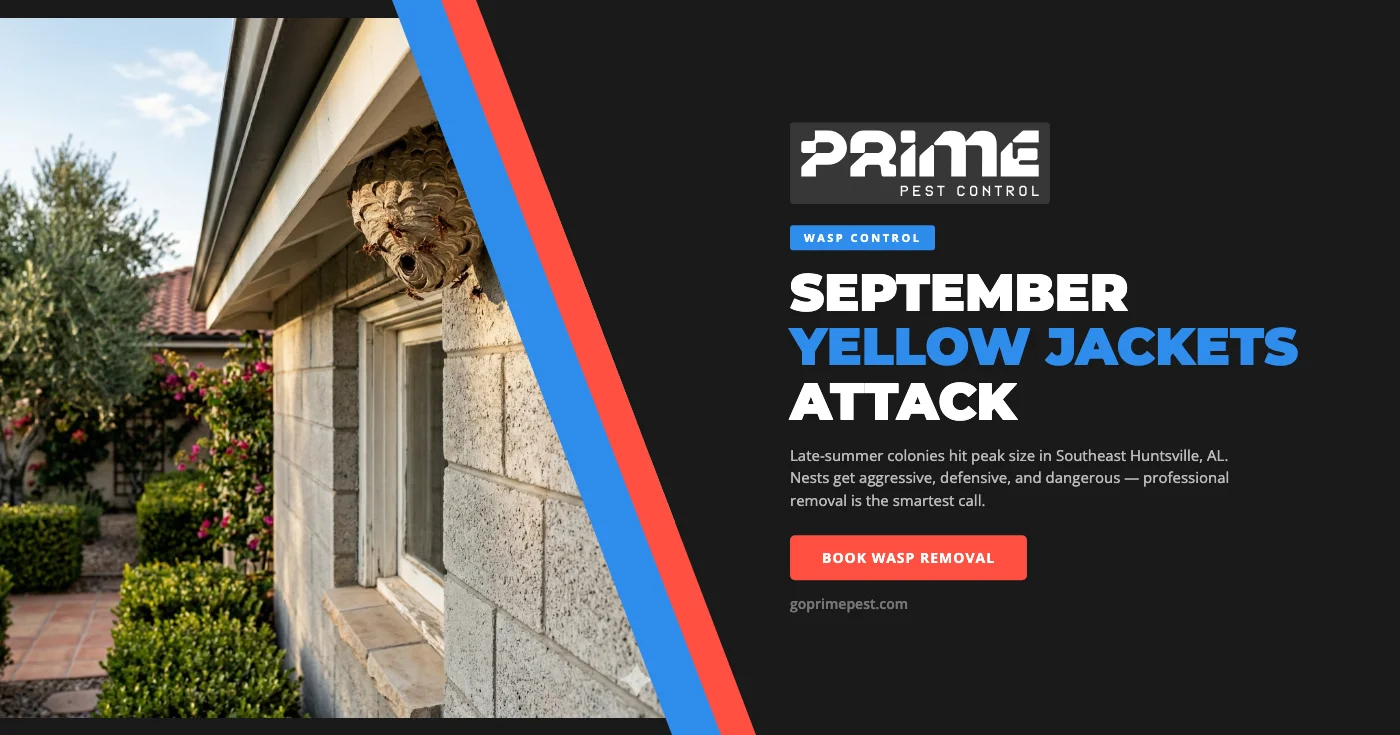
- Aerial paper nests in eaves and shrubs. The football-shaped gray-paper nest most people picture is more common in paper wasps and bald-faced hornets than in yellow jackets. Our technician will identify the species before treatment because the approach differs.
Two behaviors should prompt an immediate call rather than a closer look. If you see more than one worker returning per second to the same opening, the colony is mature and stings will follow any disturbance. If you have been stung near the location, back away — yellow jackets release an alarm pheromone that stays on skin and clothing for hours and recruits nestmates to the same target.
Common DIY Mistakes That Make Yellow Jacket Problems Worse
Almost every serious sting incident we respond to in Southeast Huntsville started with a homeowner attempting the nest personally. If you are weighing a DIY attempt against calling for stinging insect control Madison AL residents can count on, the following are the mistakes most likely to end badly:
Gasoline in a ground nest. Passed around online constantly, and genuinely dangerous. Vapor can ignite from a lawn mower spark, it kills soil biology in a several-foot radius, and it is illegal to apply as a pesticide in Alabama — and it frequently fails to reach the queen anyway.
Boiling water down the entrance. Yellow jacket nests sit 12 to 18 inches below the surface with turns and branches in between. The water cools rapidly, spooks the surface workers into a defensive swarm, and leaves the queen and brood untouched.
Wasp foam at the wrong time of day. Aerosols can work on an isolated aerial paper wasp nest at dusk when foragers are home. Applied at midday they hit an empty nest and leave hundreds of returning foragers to defend the area for the rest of the afternoon.
Sealing a wall-void entrance. Homeowners notice yellow jackets going in and out of a soffit or brick weep hole and caulk it shut. The workers then chew through drywall from the inside and emerge in a bedroom. We have handled several late-season Southeast Huntsville calls where this turned into an indoor swarm.
Approaching in shorts and a T-shirt. Yellow jackets sting exposed skin and can sting through thin fabric pressed against skin. Every attempt without full-coverage clothing, gloves, and eye protection is a multi-sting story waiting to happen.
What Professional Stinging Insect Control Looks Like at Prime Pest Control
Our September wasp control Southeast Huntsville AL program is designed around three principles: identify the species before treating, treat when the entire colony is present, and follow up to confirm the queen is dead.
- Full inspection and species identification. Before we treat anything, our technician confirms the species. Honeybee swarms get referred to a local beekeeper for relocation rather than sprayed — honeybees are pollinators we protect, not a pest we treat. Yellow jackets, paper wasps, bald-faced hornets, and European hornets each require a different approach, and misidentification is the most common reason a DIY attempt fails.
- Targeted treatment at the right time of day. For ground-nesting yellow jackets we apply an EPA-registered insecticidal dust directly into the burrow at dusk or after dark, when every forager is home. The dust is carried down on the workers' bodies and reaches the queen over the following 24 hours. For aerial paper wasp and hornet nests we apply a fast-knockdown aerosol from a distance at the same low-light window.
- Reinforcement and nest removal. We return 48 to 72 hours later to confirm zero traffic and, where the location allows, physically remove the nest. This prevents overwintering queens from re-using the cavity and eliminates the residual alarm pheromone that would otherwise attract stragglers.
- Exclusion recommendations. After clearing the colony, our technician walks the property and flags the soffit gaps, brick weep holes, and rotted wood cavities that could host next year's queen. Sealing these before winter is the highest-return step for reducing next-year colony pressure.
- Documentation and warranty. Every household gets a written record of what we treated, where, with what product, and what to watch for. If activity returns within our warranty window, we re-treat at no additional charge.
For homeowners weighing a professional service against another weekend of DIY, the September calculus is straightforward. Colonies are the largest they will be all year, aggression is at its peak, and the cost of a botched attempt — stings, ER visits, insulation destroyed by workers chewing into a wall void — outweighs the cost of a properly executed treatment.
Protecting Your Southeast Huntsville Family and Pets from Late-Season Stings
Most yellow jacket stings hurt, swell for a day, and resolve on their own. A meaningful minority do not, and September is when Madison County urgent-care and ER visits for sting reactions climb every year.
The American College of Allergy, Asthma and Immunology reports that between 1.6 and 5.1 percent of Americans have experienced a severe systemic reaction to an insect sting, and that stinging insects cause an average of 72 deaths per year in the United States. Someone who has had a serious reaction once faces a 60 percent chance of a similar or worse reaction to a future sting from the same species. Yellow jackets account for the majority of these cases nationally.
The warning signs of anaphylaxis that require an immediate 911 call and epinephrine include throat swelling or hoarseness, tightness in the chest, difficulty breathing, hives away from the sting site, sudden dizziness, and loss of consciousness. Any of these after a sting is a medical emergency, not an ordinary allergic response.
Practical protection through the September peak:
- Keep prescribed epinephrine auto-injectors current and accessible if anyone in the household has a known stinging-insect allergy. Check expiration dates every fall.
- Cover sweet drinks and food on the deck. An open soda or a plate of watermelon draws yellow jackets from a surprising distance in September.
- Keep trash and recycling bins sealed. The Alabama Extension calls out garbage and recycling as scavenger targets. Rinse recyclables and keep the lid latched.
- Watch kids and pets around ground-level landscaping. Dogs sniffing under a shrub and children chasing a ball into a mulch bed are the two most common paths to a mass-sting event from a hidden ground nest.
- Never swat. Crushing a worker releases the alarm pheromone. Walk away calmly, get inside, and change clothes if a sting has occurred.
- Retreat if you spot the zigzag flight. If you see the telltale side-to-side landing pattern near a spot in the yard, mark it mentally and stay clear.
Why Stinging Insect Activity Lingers Deep Into Alabama's Fall
Yellow jacket problems in Southeast Huntsville do not end when the calendar flips to October. Because North Alabama typically does not see a killing frost until late October or early November, our region hosts active colonies for weeks longer than states farther north. That extended window shapes how we schedule wasp nest treatment North Alabama homeowners rely on.
Three fall-specific dynamics matter. First, mature colonies produce new queens and males in mid-September through early October. Mated queens look for sheltered overwintering spots — attic corners, wall voids, stacked firewood, and rotted tree hollows. Every queen that survives winter starts a new colony next April, so reducing overwintering opportunities in October has measurable payoff in June.
Second, once the first hard frost hits, workers and the old queen die within a week. The nest itself does not clear — the paper structure inside a wall void and the aerial football under an eave both persist and attract carpet beetles and dermestid larvae that move on to fabrics inside the home. Late-fall removal closes that loop.
Third, bald-faced hornets and European hornets remain active longer than yellow jackets and often become the dominant stinging insects in Southeast Huntsville in late October. Bee removal Southeast Huntsville families request in September fits here too — true honeybee colonies are rare in early fall but do occur, and we refer them to a beekeeper for live removal at no cost to the homeowner rather than treat them chemically.
If your property has active nests, if anyone in the household has a known sting allergy, or if you have been putting off the wall-void hum in the guest bedroom, September is the window that matters.