
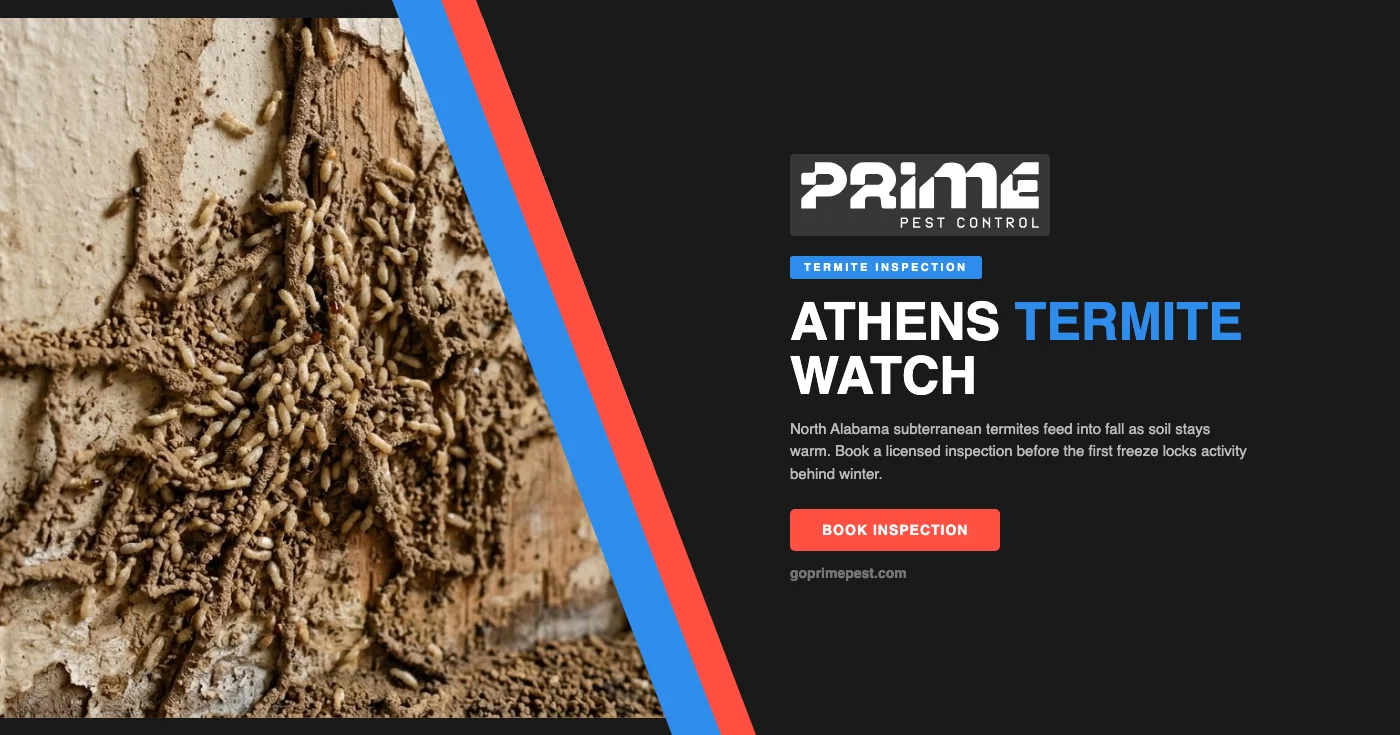
If you own a home in Athens, AL, October is the month to lock down your termite inspection before the ground firms up for winter. Subterranean termites — the species behind nearly all termite damage in north Alabama — do not migrate south when the temperature drops. They pull deeper into the soil, keep feeding on the wood inside your walls, and continue expanding a colony that will surge again next spring. A fall inspection is what turns that unseen activity into information you can act on.
At Prime Pest Control, we perform termite inspections across Athens and the surrounding Limestone County corridor every autumn. Below is why the September–November window is the right one for a professional inspection, how subterranean termites actually behave in the north Alabama climate, and what your household should know before the first hard freeze pushes the colony into slower-motion winter mode.
Why Fall Is the Best Time for a Termite Inspection in Athens, AL
Termite inspection timing matters more than most Athens homeowners realize. Spring is when swarmers get the attention — the winged reproductive termites that appear on window sills in April and May are the year's most visible signal of an established colony. But by the time you see a spring swarm, the colony has already been feeding on your home for years. Fall is the earlier, quieter window in which the same colony is still fully active and still leaves the evidence a trained technician needs to find it.
Three factors make September through November the right inspection window for Athens homes. First, soil moisture in Limestone County remains high through the fall rain events that follow late-summer humidity, so mud tubes, water damage, and moisture-tracking termites are easier to spot than they will be in the drier weeks of January and February. Second, homeowners typically switch on heating systems for the first time in October, and that first warm cycle draws termite workers toward wall voids near baseboards and along foundation lines — activity that a technician can pick up on. Third, addressing an infestation now — before the colony's winter dormancy — protects the wood inside your Athens home from a full quarter of a year of continued feeding.
How Subterranean Termites Behave in North Alabama's Climate
Eastern subterranean termites are the dominant species in Athens and everywhere else in north Alabama — Meridianville, Toney, Huntsville, Madison, and out through Owens Cross Roads. Understanding their year-round rhythm makes the case for a fall inspection self-evident.
Subterranean termites live in the soil and forage upward into the wooden framing of a home through a network of mud tubes that keep their body moisture intact. According to the Alabama Cooperative Extension System, termites "are the most destructive and costly insects, affecting large numbers of wood structures and causing more than $5 billion in property damage annually in the United States." Alabama's soil moisture and mild winters keep colonies active in every season — the workers that do the structural damage feed continuously, whereas the swarming reproductive caste is a spring-only phenomenon.
North Alabama's climate profile — long humid summers, wet autumns, and mild freeze-thaw winters — puts Athens homes under termite pressure year-round. Colonies do not die back the way they may in northern climates. They pull four to six feet below grade in December and January, then rise back toward the surface as spring pushes the frost line upward. In practical terms, the termite colony feeding on your Athens home in September is the same colony that will feed on it in April, unless it is caught and treated first.
The red clay and clay-loam soils across Limestone County hold moisture longer than sandy soils farther south, which produces the wet-below, dry-above stratum that subterranean termites prefer. Properties near creek bottoms, in older subdivisions with mature landscaping, and on lots where soil has settled against the foundation face particularly high termite pressure.
Warning Signs of Termite Damage Athens Homeowners Should Watch For
By the time a homeowner sees clear termite damage in the living space, the colony has been at work for months or years. Catching the earlier signs is what a fall inspection is for — but Athens homeowners can also do a monthly self-check on the following high-yield indicators.
- Mud tubes on foundation walls or piers. Pencil-width tubes of dried mud running up a foundation, crawlspace pier, or brick veneer are the single most reliable signal of an active subterranean colony. Tubes can be intact or abandoned — we treat both as evidence of past or present activity.
- Discarded wings around door frames, windows, or light fixtures. After a swarm, reproductive termites shed their wings in matching translucent piles. The wings you find in September or October are typically from a spring swarm that went unnoticed at the time.
- Hollow-sounding or blistered wood. Tap a screwdriver handle against baseboards, door frames, and window sills — a hollow, papery sound is diagnostic. Blistering paint on baseboards where no water leak explains it usually indicates termite galleries directly behind the drywall.
- Warped door frames or sagging trim. When wall studs or plates are compromised, doors and windows begin to bind and trim work develops visible gaps. In older Athens homes, ceiling drywall around the perimeter may develop a faint sag before any other termite sign appears.
- Sticking floors near exterior walls. Subfloor damage from a termite colony traveling under wall-to-floor joints produces a spongy feel that homeowners often attribute to old flooring or humidity.
A five-minute homeowner check — probing baseboards, door frames, and window sills along exterior walls with a flathead screwdriver — surfaces the majority of do-it-yourself detections. Anywhere the wood gives more easily than expected, or where the tool punches through what looked like solid trim, gets flagged for a professional termite look. Athens homeowners who run this quick check monthly through the fall catch the earliest warning signs and set up a shorter, less invasive treatment window later.
How Irrigation and Landscaping Create Termite Entry Points Around Athens Homes
Termite pressure is not distributed evenly across a property. The wettest, warmest quarter of a home's soil footprint is where subterranean workers concentrate, and the choices Athens homeowners make with irrigation, mulch, and shrub placement determine how attractive that quarter becomes. The following landscape and grade features consistently drive termite pressure on the Athens homes we inspect:
- Irrigation heads that spray the foundation. A pop-up sprinkler adjusted to soak the flower bed against the house delivers hundreds of gallons of moisture directly onto the sill plate over a season. Rotate irrigation heads away from the foundation, or step them off by at least twelve inches.
- Mulch depth greater than three inches within a foot of the foundation. Deep hardwood mulch holds moisture and provides a cellulose food source at the point of contact. Two inches maximum, and pull the mulch back to expose the top of the foundation footer.
- Wood-to-soil contact from decks, planter boxes, and stair stringers. Every point where untreated lumber meets soil is a direct entry ramp. Deck posts should sit on concrete piers, planter boxes should be lined or drained, and porch skirting should have a two- to four-inch inspection gap at the base.
- Downspout discharge within six feet of the foundation. A short elbow that dumps roof water at the base of the wall creates a saturated soil corridor for termite workers. Extend downspouts to eight or ten feet of throw, and grade the ground away from the house.
- Shrubs and hedges pressed against the exterior wall. Hollies, boxwoods, and azaleas trap humidity against the brick or siding and shield termite mud tubes from view. Prune everything back to twelve inches from the wall.
- Cracked or missing gutters. A gutter that overflows during a fall thunderstorm delivers a concentrated soaking that lingers in Limestone County clay soil for days.
These landscape changes are the single highest-yield preventive step for Athens homeowners. On the properties where we return year after year to find no new activity, the shared factor is not the treatment product used — it is that the household stopped watering the foundation.
What to Expect During a Professional Termite Inspection
A thorough termite inspection is a two- to three-hour visit for a typical Athens home, split roughly evenly between exterior and interior work. The inspection is documented, and the report should identify not just current activity but conducive conditions that raise your risk profile for the next twelve months.
Our inspection protocol covers the following steps in order:
- Exterior perimeter walk. Every foot of foundation is checked for mud tubes, wood-to-soil contact, drainage concerns, and construction gaps at penetrations. We flag every irrigation head aimed at the house and every downspout discharging within six feet of the wall.
- Crawlspace or basement inspection. Where accessible, the substructure gets a full sweep — sill plates, piers, subflooring, joists, and any wood in contact with soil or masonry. Moisture readings on framing members flag the wet-wood conditions termites exploit.
- Interior perimeter walk. Baseboards, door frames, and window sills along exterior walls get probed and tapped. We look under sinks, in laundry rooms, and around water heaters — anywhere plumbing or HVAC condensation could produce the moisture profile termites need.
- Attic and roof-line check. Rafters, roof sheathing, and the top plates of exterior walls get a visual sweep for termite activity, which does reach attic wood in older Athens homes.
- Written findings and treatment recommendation. Every finding is documented with location, evidence type, and severity. Where a treatment is needed, we present both liquid termiticide barrier and in-ground bait station options, calibrated to the home's construction and lot profile.
According to the University of Kentucky Entomology Extension, "ridding a home of termites requires special skills. A knowledge of building construction is needed to identify critical areas where termites are likely to enter." That single passage explains why every credible termite program is built around a licensed inspector rather than a checklist — the same wall configuration that keeps termites out of a slab-on-grade home can invite them into a crawlspace home two doors down.
Prevention Steps Athens Homeowners Can Take Before Winter
Even with a fall inspection scheduled, the prevention work Athens homeowners do in the weeks before the first freeze meaningfully reduces the pressure a colony can put on the home over the winter. The highest-yield steps take one weekend, not one season.
Fix moisture at the source. Any plumbing leak, HVAC condensate line, or gutter separation that has been ignored through the summer becomes a winter termite magnet. Fix the leak first, then dry the affected wood.
Move firewood off the ground and away from the house. Stack firewood on a raised rack at least twenty feet from any exterior wall. A stack against the deck is one of the most common ways termite pressure gets established on a previously clean property.
Reduce cellulose contact. Untreated lumber scraps, old landscape timbers, and cardboard stored in a crawlspace all feed termites. Clear the crawlspace of cellulose debris in October, before winter access becomes uncomfortable.
Seal foundation cracks and penetrations. Every hairline crack in the foundation wall, every gap around a plumbing penetration, and every dryer-vent gap is a potential termite entry point. Silicone or polyurethane caulk applied before winter closes the pathways termites use most.
Schedule the inspection. Prevention buys time; the inspection buys the information the treatment plan is built around. On the Athens properties where we intervene early, exclusion and monitoring alone often carry the household through years without an active termite infestation.
When to Call a Professional Termite Inspector in Athens, AL
Some situations do not wait for the annual schedule. Call a licensed termite inspector immediately if you see any of the following at any point in the fall:
- Mud tubes on a foundation wall, crawlspace pier, or in a basement — active or abandoned.
- Piles of translucent wings on window sills, around door frames, or beside light fixtures after a warm rainy day.
- Hollow-sounding trim, sticking doors, or blistered baseboards where no water leak explains the damage.
- A visible swarm inside the house at any time of year — swarming indoors indicates the colony is already within the structure.
- A real-estate transaction, refinance, or insurance inspection that requires an official termite letter within the next thirty days.
Our team handles termite treatments and inspections for Athens homeowners across the full range of situations above. Every visit begins with the inspection protocol described earlier — even for a routine real-estate letter — because the information the inspection produces is the foundation the rest of the termite plan sits on. If activity is present, we discuss liquid termiticide versus bait station strategy and document the treatment plan in writing before any work begins. If activity is absent, the inspection becomes the baseline against which next year's inspection is compared, and we identify the highest-yield exclusion changes for the property.
We serve Athens, Limestone County, and the wider north Alabama corridor from our Madison location — Meridianville, Toney, Huntsville, Madison, Owens Cross Roads, Wall Triana, and Harvest. Scheduling a fall termite inspection now buys the peace of mind of knowing exactly what the winter will bring, and gives your household the runway to address any findings before spring swarming season pulls the colony's next generation to the surface.