
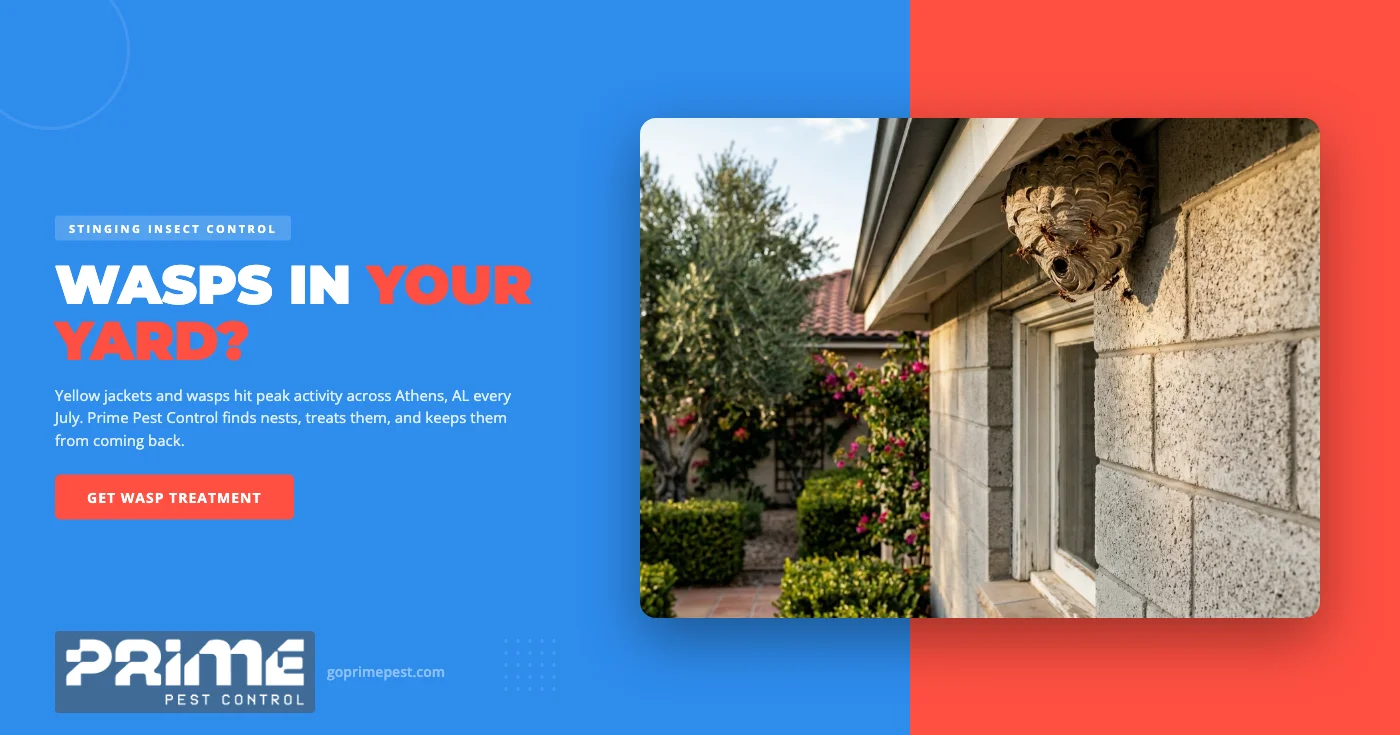
If you've noticed wasp and yellow jacket activity increasing around your Athens, AL home this summer, you're not imagining it. July marks the point in the season when stinging insect colonies across Limestone County reach their peak population — workers from spring-founded nests have been reproducing steadily since April, and by midsummer a single yellow jacket colony can contain 3,000 to 5,000 workers. That population density, combined with late-summer food competition and pre-fall behavioral changes, makes July and August the months when stinging insect encounters are most frequent and most serious.
At Prime Pest Control, we provide professional stinging insect control services in Athens, AL and throughout Limestone County. Understanding the species active in the area, where they nest, and when to call for professional help is essential for keeping your family and guests protected through the rest of the summer season.
Stinging insect colonies in north Alabama operate on a predictable seasonal cycle. Queens emerge from overwintering in spring and begin founding new nests — initially alone, building just a few cells and laying the first eggs of the new colony. Through spring, worker populations grow slowly as the first generation of workers matures and begins foraging and expanding the nest.
By June and July, worker populations have grown exponentially. Each new worker contributes to nest expansion and foraging, and the colony grows faster as more workers are present. This exponential growth continues through midsummer, when colony size peaks before the colony begins producing the new queens and males that will mate and establish next year's overwintering population.
Late summer also brings behavioral changes that make stinging insects more aggressive. As the colony approaches the end of its productive season, worker behavior shifts from focused foraging to defensive nest protection. Workers that encounter perceived threats near the nest entry or near food sources are more likely to sting. Yellow jackets in particular become increasingly aggressive in August and September as colonies decline and food sources become scarcer.
Athens's warm, humid summers are ideal for stinging insect activity. Limestone County's mix of residential development, agricultural land, wooded edges, and creek corridors provides abundant nesting sites and foraging resources — particularly for species that nest in the ground or in structural voids rather than in the exposed paper nests that most people associate with wasps.
Several stinging insect species are commonly encountered in and around Athens homes. Accurate identification helps determine appropriate response — both in terms of urgency and treatment approach.
Yellow jackets — The stinging insect most frequently responsible for painful encounters in residential settings, yellow jackets are 0.5-inch-long wasps with bright yellow and black bands. In north Alabama, Eastern yellow jackets and Southern yellow jackets are the predominant species. Yellow jackets frequently nest in the ground — in abandoned rodent burrows, under sidewalk slabs, in landscape beds, and beneath decking — making their nests nearly impossible to locate until disturbed. They also nest in wall voids and attic spaces inside structures. Yellow jackets are highly defensive and will sting multiple times when their colony is disturbed.
European paper wasps and native paper wasps — Slender, orange-and-black or brown-and-yellow wasps that build the characteristic umbrella-shaped open-celled paper nests commonly found under eaves, in shrubs, under deck railings, and inside garage door tracks. Paper wasps are less aggressive than yellow jackets and will generally sting only when the nest is directly threatened. However, nests built in frequently accessed locations — doorways, play equipment, outdoor furniture — present repeated encounter opportunities.
Bald-faced hornets — A large, black-and-white stinging insect that builds the enclosed, basketball-sized gray paper nests often found hanging from trees, shrubs, and eaves. Bald-faced hornets are highly aggressive in defense of their nests and will chase perceived threats significant distances. A nest this size should not be approached or treated without professional equipment and protection.
Cicada killers — Large, intimidating solitary wasps that dig individual burrows in sandy or bare soil areas, frequently in lawn edges, landscaping beds, and garden borders. Despite their size, cicada killers are docile and pose minimal sting risk to humans — females very rarely sting when not handled. However, large numbers of burrows in a single area can be alarming and can damage lawn and landscape areas.
Most stinging insect problems begin with a nest that was established in spring and went unnoticed while the colony was small. By the time the nest is discovered in midsummer, the colony population is large enough to pose a meaningful sting risk during removal.
Inspect these locations periodically for early nest detection — particularly in April and May when nests are small and easier to address:
Under eaves, soffits, and roof overhangs — paper wasp queens commonly start nests in sheltered overhead locations in early spring. A nest the size of a golf ball is a single queen's work from the first weeks of spring; by July, it can contain dozens of workers.
Inside garage door tracks and frames, inside grill storage areas, beneath deck boards, inside outdoor equipment stored through winter — enclosed, undisturbed spaces are prime paper wasp and yellow jacket nesting locations.
In the ground — particularly in areas of bare soil, landscape beds with loose or sandy soil, and the edges between lawn and garden. Mowing over a buried yellow jacket colony is one of the most common causes of serious stinging incidents in residential settings.
In structural voids — wall cavities, crawl spaces, attic insulation, and the spaces inside concrete block or brick siding that have small exterior gaps provide interior nesting sites for yellow jackets that can result in stinging insects emerging inside the home if the nest is near an interior gap.
For most people, a wasp or yellow jacket sting produces local pain, redness, and swelling that resolves within hours to a day. Multiple stings from a disturbed colony produce more significant symptoms but are typically manageable with normal first aid — cleaning the area, applying cold, and monitoring for signs of systemic reaction.
The significant risk from stinging insect encounters is allergic reaction — anaphylaxis. An estimated 1 to 2 percent of the population has a severe venom allergy, and anaphylaxis can develop even in individuals who have been stung multiple times previously without serious reaction. Signs of anaphylaxis include hives or swelling extending beyond the sting site, throat tightening or difficulty breathing, nausea, dizziness, or rapid heartbeat following a sting. Anaphylaxis requires immediate emergency medical attention.
Anyone who has previously experienced a systemic allergic reaction to a sting should carry an epinephrine auto-injector (prescribed by their physician) and discuss further evaluation with an allergist regarding venom immunotherapy options.
For encounters with large, aggressive colonies — particularly bald-faced hornet nests or hidden ground-nesting yellow jacket colonies — professional removal reduces the sting risk significantly compared to homeowner attempts.
Prevention starts with reducing nesting site availability and foraging attractants around your property.
Inspect eaves, soffits, and all sheltered overhead locations monthly during spring and early summer. Small nests treated early in the season require less intervention and involve fewer risks than fully developed summer colonies.
Seal gaps and entry points in exterior walls, particularly around utility penetrations, vents, and expansion gaps in masonry. Yellow jackets entering structures through small gaps to nest in wall cavities can be extremely difficult to treat once established.
Keep outdoor garbage cans tightly lidded and away from outdoor dining areas. Yellow jackets are strongly attracted to sweet drinks, protein foods, and meat — particularly in late summer when colony food demands are highest. Using lidded cups for outdoor drinks and keeping food covered significantly reduces yellow jacket encounters at outdoor gatherings.
Avoid wearing strong floral fragrances outdoors during peak season. Keep an eye out for increased foraging activity in any fixed location — a concentration of wasps returning repeatedly to one spot on your property often indicates a nearby nest entrance.
Professional stinging insect treatment by Prime Pest Control addresses both exposed nests and hidden nesting sites that present higher risks during homeowner removal attempts. We use appropriate personal protective equipment, professional-grade insecticides, and treatment approaches matched to the specific species and nest location.
For aerial nests — paper wasp colonies, bald-faced hornet nests — treatment typically involves applying insecticide directly to the nest in the evening when foragers have returned and worker activity is minimal. For ground-nesting yellow jacket colonies, we locate the entrance and apply insecticide treatment that reaches the nest cavity. For structural infestations in wall voids, we apply treatment through exterior gaps and may recommend monitoring to confirm full colony elimination before sealing entry points.
If you're seeing significant wasp or yellow jacket activity around your Athens, AL home, or if you've discovered a nest in a location that puts family members or guests at risk, contact Prime Pest Control for professional stinging insect control in Athens and throughout Limestone County.