
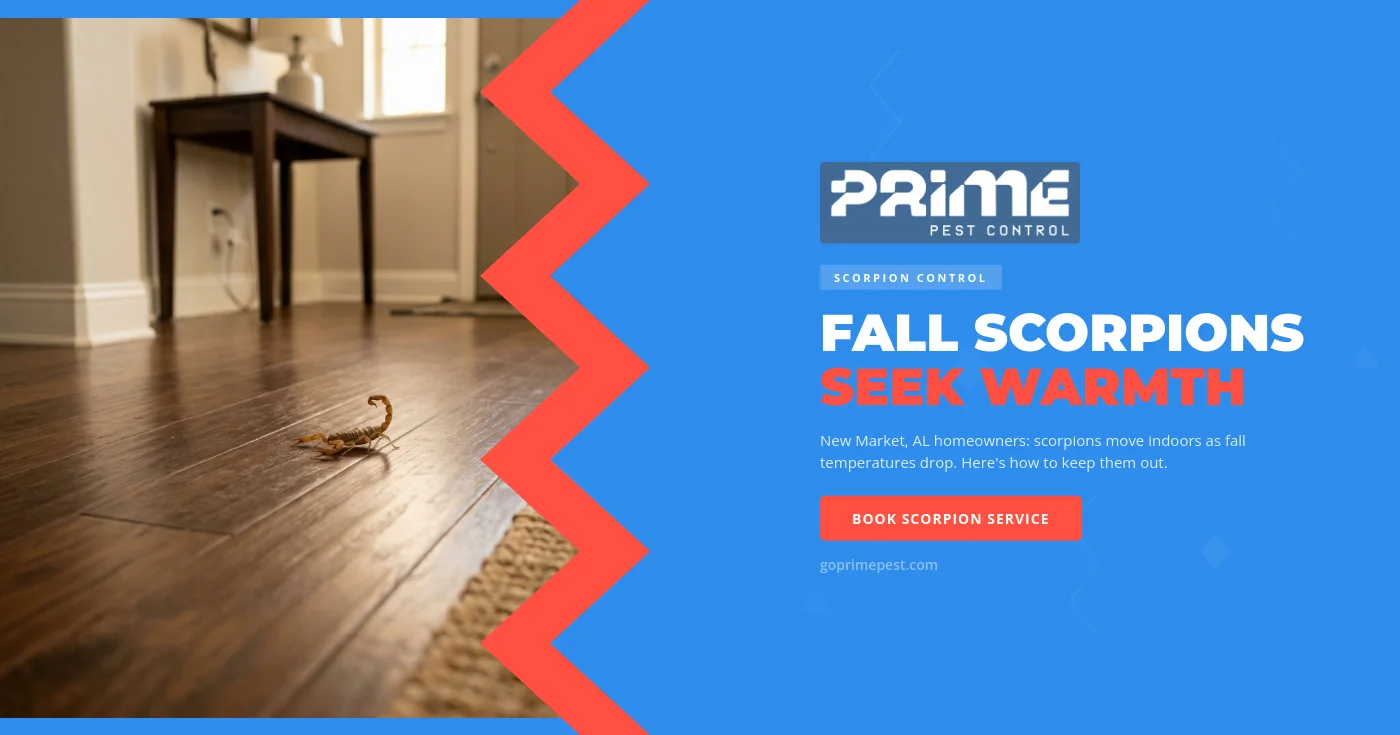
The first stretch of cool nights in New Market usually arrives in early October, and it changes the pest-pressure pattern across North Alabama in ways most homeowners never associate with the calendar. Daytime temperatures in the Tennessee Valley may still reach the upper 70s, but the mid-50s overnight lows push cold-blooded animals that spent summer under rocks, logs, and firewood piles toward the warmest cavity they can find. For a surprising number of New Market households, that cavity turns out to be a garage, a crawl space, or a basement — and the animal that turns up in a shoe or along a baseboard is a scorpion.
At Prime Pest Control, we handle general pest control across New Market, Hazel Green, and the wider Madison County corridor every fall. Scorpion calls are a small share of our volume compared to roaches or spiders, but they are the ones that generate the most alarm — most New Market residents have no idea Alabama has native scorpions at all until they find one in a laundry basket. The sections below cover why scorpions genuinely do live in this part of the state, what drives them indoors as fall sets in, which entry points they use, how to reduce pressure on your property, and when professional treatment is the right call.
Are Scorpions Really Found in New Market, AL?
Yes — and the species that lives in and around New Market is almost certainly one most homeowners have never heard of. According to the Alabama Cooperative Extension System, Alabama has two native scorpion species: the Hentz striped scorpion (Centruroides hentzi), which lives in the coastal counties of the state's southern tier, and the southern unstriped scorpion (Vaejovis carolinianus), which inhabits the piedmont and mountain areas of the state. New Market, sitting in the Tennessee Valley just below the Highland Rim, falls squarely inside the southern unstriped scorpion's range.
The southern unstriped scorpion is small — adults typically reach less than two inches from pincer to stinger — with a uniformly dark grey, dark brown, or near-black body. There are no bold stripes and no bright coloration. In a dim garage or a shaded corner of a crawl space, a southern unstriped scorpion is easy to mistake for a large cricket or a dark spider at first glance. The telltale features are the pair of forward pincers and the segmented tail curled over the back with a bulbous terminal segment and stinger.
The good news for New Market households is that neither of Alabama's native scorpion species is medically dangerous. ACES notes that a sting from the southern unstriped scorpion produces localized pain comparable to a wasp sting, with symptoms typically subsiding within about thirty minutes. There are no reliably documented fatalities from native Alabama scorpions. The arrival of a scorpion inside a New Market home is a nuisance and a well-being concern — especially for households with young children or anyone with a known arthropod-sting allergy — but it is not the kind of medical emergency the desert-dwelling scorpions of the Southwest would represent.
Why Scorpions Move Indoors as Fall Temperatures Drop
Scorpions are ancient animals — arachnids, like spiders and ticks — and they share a biological ceiling with every cold-blooded predator in North Alabama: they cannot regulate body temperature internally. The southern unstriped scorpions that live in and around New Market spend spring and summer in exactly the places their biology prefers: beneath flat rocks on wooded hillsides, under the bark of dying trees, inside leaf litter, under landscape timbers, and beneath the stacked firewood common on properties out toward Hazel Green and Toney. Through the warm months, those outdoor harborage points supply three things scorpions need: stable temperatures, trapped humidity, and a steady food supply of crickets, roaches, spiders, and other small arthropods.
Fall disrupts every piece of that equation. As overnight lows drop into the 50s and then the 40s through October and November, the shallow harborage under rocks and bark loses its temperature buffer. Humidity falls across North Alabama with the shift from summer thunderstorm patterns to drier autumn air masses, and the leaf-litter microclimate that held moisture through August dries out. The outdoor insect populations scorpions prey on also contract — crickets stop calling, roach activity falls off, and the easy summer menu disappears. Faced with cooling, drying, and shrinking food, scorpions do what their biology compels them to do: they migrate toward the warmest, dampest, best-fed microclimate within reach. For a scorpion sheltering under a landscape stone fifteen feet from a New Market foundation, the warm concrete slab under an attached garage is a magnet.
Add one more wrinkle. Southern unstriped scorpions give live birth rather than laying eggs, and the young ride on the mother's back until after their first molt. A female scorpion looking for a protected overwintering site is not just looking for warmth for herself — she is looking for the right microclimate to carry a brood through to spring. That is why the scorpions New Market homeowners find inside in October and November are so often in the quietest, most undisturbed corners of the house: the back of a utility closet, the far end of an unfinished basement, the stored holiday-decoration boxes in a garage attic.
Common Entry Points Scorpions Use to Get Into Your Home
Scorpions do not need a large opening to get into a New Market home. ACES documents that scorpions can pass through gaps as small as one-eighth of an inch. The entry points we find most often in Madison County inspections are the same handful of structural weak points that let in most cool-season invaders:
- Gaps under exterior and garage doors. The rubber threshold seal on a garage door tends to go brittle after two or three Alabama summers and no longer meets the slab tightly. A half-inch gap along the bottom of a garage door is the single most common scorpion entry route we identify in New Market inspections.
- Weep holes in brick veneer. Newer construction across New Market and Hazel Green uses brick veneer with small weep holes near the foundation to allow moisture to escape the wall cavity. Uncovered weep holes are an open path from the exterior grade into the wall void.
- Plumbing and utility penetrations. Every home has gaps where water lines, gas lines, electrical conduit, or AC refrigerant lines pass through the foundation or siding. Cracked caulk or missing foam around these penetrations is a highway for scorpions and the insects they are chasing.
- Crawl-space vents and foundation cracks. Older New Market homes with vented crawl spaces are especially vulnerable in fall. Torn vent screens, missing vent covers, or small foundation cracks give scorpions direct access to the dampest, most stable microclimate on the entire property.
- Firewood and debris stacked against foundations. Firewood piled against the side of the house is a scorpion dormitory with a one-step commute into the structure. Leaf piles, old lumber, and landscape timbers against the foundation serve the same role.
- Attached garages with slab-wall gaps. The expansion joint between a garage slab and the adjoining house wall is often an unsealed crack a quarter-inch wide. Scorpions crossing from a wood pile into the garage frequently travel this seam into the living space beyond.
Inside the home, scorpions concentrate in the rooms that stay dark, warm, and undisturbed: basements, crawl spaces, utility closets, laundry rooms, mud rooms, and attached garages. They will also work their way into bedrooms when a long stretch of outdoor cold pushes them deeper into the structure — which is why shaking out shoes before putting them on becomes genuinely practical New Market advice from October through February.
How to Scorpion-Proof Your New Market, AL Property This Fall
Scorpion pressure around a New Market home responds strongly to habitat modification. The most effective prevention work a homeowner can do before calling our team is environmental — reduce the places where scorpions shelter near the house and the paths they take to get inside, and the pressure drops accordingly. The steps below are the ones we routinely see move the needle on New Market properties:
- Move firewood at least twenty feet from the foundation and off the ground. Stack firewood on a rack, not on the dirt, and never against the side of the house or inside an attached garage. This single step eliminates the most common harborage source on most New Market properties.
- Clear landscape debris from the foundation line. Leaf piles, old mulch, loose stones, decorative timbers, and stacked lumber within a few feet of the foundation all serve as scorpion staging ground. Pull them back three to five feet and the pressure at the wall drops significantly.
- Seal exterior gaps. On a bright afternoon, walk the perimeter of the home and look for every crack, gap, and worn seal — foundation seams, utility penetrations, garage-door thresholds, dryer vents, and crawl-space vents. Silicone caulk, expanding foam, fresh door sweeps, and a new garage threshold seal close the entry routes scorpions and the insects they chase both rely on.
- Fix moisture problems. Scorpions follow humidity. A leaking hose bib, a disconnected gutter downspout dumping water against the foundation, a crawl space with standing moisture, or an AC condensate line draining right at the slab all create the damp microclimates that pull scorpions in close. Repair those sources first.
- Rethink outdoor lighting. Bright porch and landscape lights attract moths, crickets, and other insects — which in turn attract the scorpions that eat them. Switching to yellow or amber bulbs in exterior fixtures (or motion-activated lights that only run on demand) cuts the insect buffet that draws scorpions toward the house in the first place.
- Shake out shoes, towels, and laundry. From October through winter, a quick shake of a shoe before putting it on, or a toss of a folded towel before use, is a reasonable precaution for New Market households that have found scorpions in previous seasons. It is a thirty-second habit that eliminates nearly all accidental stings.
None of these steps individually will stop every scorpion from testing the perimeter of a New Market home. Together, they shrink the resources scorpions need to settle in close and make professional treatment more durable when it is time to involve us.
What to Do If You Find a Scorpion in Your Home
Finding a scorpion inside a New Market home is unsettling, but the response is straightforward. The native southern unstriped scorpion is not aggressive — it stings defensively when cornered, stepped on, or picked up, and it would rather retreat than engage. For a scorpion spotted on a floor, in a bathtub, or along a wall, the simple response is to invert a glass or jar over the animal, slide a piece of cardboard underneath, and carry it outside well away from the house. Scorpions do not swarm or recruit nestmates — removing the single animal is the end of that specific encounter.
Capturing rather than crushing is also useful diagnostically. If the scorpion is a southern unstriped specimen, that confirms the native species and the ordinary fall entry pattern. If it is anything else — a lighter striped specimen or a larger body — our team wants to see a photograph so we can match it against the two documented Alabama species and plan treatment accordingly.
If a sting does occur, the response is similar to a wasp or hornet sting: wash the area with soap and water, apply a cold compress to reduce localized pain and swelling, and monitor for the ordinary thirty-minute pain window ACES describes. Watch anyone stung for signs of a broader allergic reaction — hives spreading beyond the sting site, swelling of the lips or tongue, difficulty breathing, lightheadedness — and seek emergency medical care if any of those develop. Children, elderly residents, and anyone with a known arthropod-sting allergy warrant a lower threshold for calling a doctor.
Why Professional Scorpion Control Matters in New Market, AL
Scorpion control is a different kind of pest management from, for example, roach control. There is no gel bait a scorpion will eat and carry back to a colony, because scorpions are solitary ambush predators. Treatment has to work through two levers at once: cut the prey population scorpions came inside hunting, and treat the perimeter and harborage points so adult scorpions do not establish inside the structure. That is the work our fall program is built around.
A professional scorpion treatment on a New Market property starts with an inspection — walking the exterior to identify the actual harborage points on this specific property (firewood against a shed, a landscape stone at the base of the chimney, a crawl-space vent with a torn screen), checking the interior rooms where scorpions are most likely to be sheltering, and documenting the entry routes between them. From that inspection we build a treatment plan that addresses the whole system: a residual perimeter application in the band where scorpions cross from harborage to foundation, targeted treatment of wall voids and expansion joints where scorpions are passing into the structure, and a reduction in the spider control and general insect pressure that is drawing scorpions in close in the first place.
For New Market households on our recurring program, that fall scorpion-focused visit integrates with the quarterly perimeter work that keeps the overall pest pressure at the property line low through winter and into next spring. Every household we treat gets a written record of what we applied, where, and under what conditions. If scorpion activity returns within the warranty window, we return at no additional charge — the goal is a resolved problem, not a recurring service call.
Fall is the moment the scorpion population in and around New Market makes its annual move toward the warmest, dampest cavity within reach. For properties with a wooded lot line, a wood pile, or a vented crawl space, that cavity is often inside the home. If you have seen a scorpion in a laundry room this month, found one in a garage, or had a close call stepping into a shoe, the window to address pressure before overwintering sets up next spring's population is open now. Prime Pest Control provides scorpion control for New Market, Hazel Green, and the wider Madison County corridor, and our fall inspections are what keep next year's indoor activity down.