
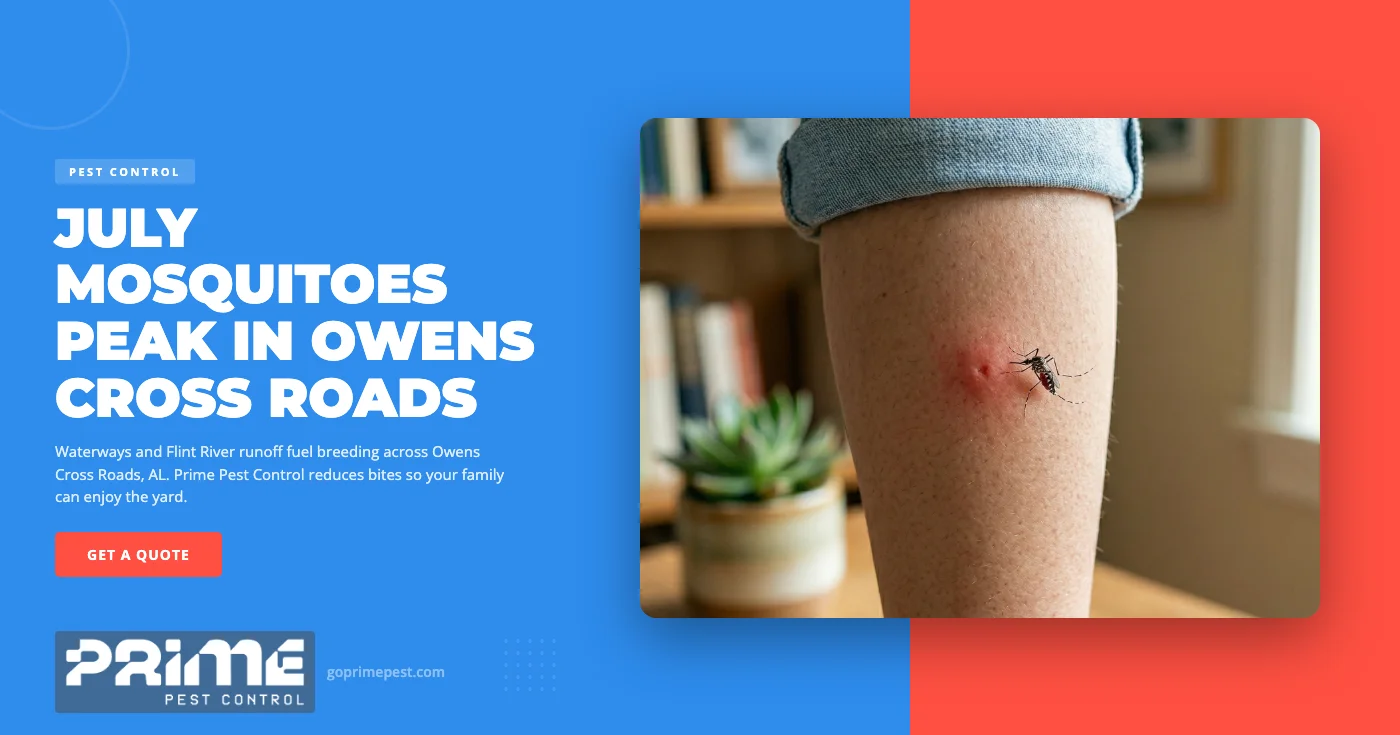
The Flint River corridor, wet backyard corners, and 90-degree humid days of July have Owens Cross Roads sitting in the thick of peak mosquito season. Populations that started small in April double every seven to ten days through spring, and by mid-July the colonies feeding across Madison County properties are at their annual maximum density. Effective mosquito control Owens Cross Roads AL homeowners can count on in July means understanding the peak-season biology, targeting the water sources feeding it, and layering treatment on top of prevention.
At Prime Pest Control, we run mosquito control service across Owens Cross Roads, Hampton Cove, and the eastern half of Madison County every week from late April through October. Below is why the pressure peaks now and how to keep your family enjoying the backyard through the hardest month of the season.
Mosquito populations across north Alabama follow a predictable ramp — a small overwintering pool of females in April, generations doubling every seven to ten days through spring, and full colony expansion into July as heat and humidity peak. By mid-July the total feeding-age population on a typical Owens Cross Roads property is the highest it will be all year. The Alabama Department of Public Health tracks arboviral disease activity most closely during this window because Culex density — the primary local vector for West Nile virus — reaches its annual maximum in July and August.
Temperature and humidity are the drivers. July daytime highs in the Big Cove and Hampton Cove valley average in the low 90s, and dew points hold in the low 70s through most weeks. That extends the daily biting window: female Aedes albopictus (the Asian tiger mosquito) bite through daylight hours in humid conditions, and Culex takes over at dusk and holds activity well into the night. Between the two species, an unprotected Owens Cross Roads backyard has essentially no low-mosquito window from mid-afternoon through midnight.
Colony math compounds the pressure. A single female lays 100 to 300 eggs per clutch, and at July temperatures the egg-to-biting-adult cycle finishes in 7 to 8 days — shortened from the 10-day cycle we track in early spring. Every water source we miss produces a fresh brood twice a month. On lots that back into wooded ravines feeding toward the Flint River, we routinely trace three or four active brood sources on a single walkthrough.
The geography that makes Owens Cross Roads a beautiful place to live also makes it one of the harder mosquito environments in Madison County. The Flint River drains south along the eastern edge of the community, and Big Cove Creek, Hurricane Creek, and dozens of unnamed tributaries thread through neighborhoods between Little Cove Road and Old Highway 431. Every one of those channels holds slow, shaded water somewhere along its run — and every stormwater culvert and low spot behind a home refills after every summer thunderstorm.
The Alabama Cooperative Extension System notes that even a small amount of standing water is enough for an Asian tiger female to deposit eggs, and around Owens Cross Roads the hidden breeding sources we see most often are the ones tied to river-corridor runoff patterns:
The Owens Cross Roads municipal mosquito control program runs adult-mosquito fogging along public rights-of-way from April through October, and that does help knock down flying populations near the roads. But municipal fogging cannot reach the interior of private lots, does not touch breeding sources, and does not leave the kind of residual protection that keeps mosquitoes off your porch between visits. Private-property treatment fills that gap.
The July mosquito surge across Owens Cross Roads is a public-health event as well as a comfort problem. The Alabama Department of Public Health tracks four established mosquito-borne illnesses in the state: West Nile virus (WNV), Eastern equine encephalitis (EEE), St. Louis encephalitis, and La Crosse encephalitis. Of these, WNV is by far the most reported in Madison County.
According to the Alabama Department of Public Health, roughly 4 in 5 people infected with West Nile virus never develop symptoms. About 1 in 5 develop fever, headache, body aches, joint pain, vomiting, or rash typically 3 to 14 days after a bite. About 1 in 150 develop severe neuroinvasive illness — encephalitis or meningitis — which can be life-threatening and disproportionately affects older adults and immunocompromised individuals. There is no vaccine and no specific antiviral treatment for humans, which is why prevention carries so much of the load.
EEE is far rarer in human cases but carries a much higher mortality rate. Because horses on the rural edges of Madison County are especially susceptible, ADPH urges horse owners across Owens Cross Roads, Gurley, and Brownsboro to keep WNV and EEE vaccinations current through the summer. Households with young children, elderly family members, or anyone with an immune-compromising condition should treat the July mosquito peak around Owens Cross Roads as a real health risk.
From a practical standpoint, the goal of any July mosquito program should not just be "fewer bites." It should be lowering the number of feeding-age females moving through the yard at all — arboviral transmission requires repeat bite opportunities, and every reduction in mosquito density lowers the odds of a WNV-carrying female ever finding your family.
The Alabama Cooperative Extension System teaches a "Four Ds" approach — Drain, Decimate, Dress, Defend — and the first matters more than the other three combined in July. Every water source removed takes an entire generation of mosquitoes out of the next two weeks.
The July prevention checklist we walk every Owens Cross Roads customer through:
Weekly water discipline, layered on top of professional yard treatment, is the single biggest lever an Owens Cross Roads homeowner has in July.
Every July we get the same questions from new Owens Cross Roads customers: What about my citronella torches? The propane fogger? The bracelet the kids wear? Should I install a misting system? DIY tools rarely move the needle on peak-season mosquito pressure, and one popular option is a category the CDC actively discourages.
Citronella candles, tiki torches, and clip-on repellents create a thin scent plume that dissipates within a few feet on any breeze. They can help while you sit inside the plume; they do nothing for the yard around you.
Ultrasonic devices and repellent wristbands do not deter biting females in field testing. Bug zappers kill huge numbers of beneficial insects but few mosquitoes, which are drawn far more strongly to carbon dioxide than to UV light.
Big-box propane foggers knock down adult mosquitoes briefly, but the residual is short and the application rarely reaches the shaded undersides of leaves where mosquitoes rest during the day. Within a few hours the next wave arrives from the neighboring lot.
Homeowner misting systems are the costliest misstep. The CDC does not recommend residential misting systems because they spray on a timer without any regard for actual mosquito presence, expose pollinators during their active daytime hours, and accelerate insecticide resistance because nothing is being monitored or rotated.
Our July program on an Owens Cross Roads property looks nothing like a yard fogger. A trained technician walks the lot for breeding sources first, then applies an EPA-registered residual product with backpack mist blowers calibrated to coat the resting surfaces mosquitoes actually use — undersides of shrub leaves, mulch beds along the foundation, fence-line vegetation, the shaded crawl beneath the deck, and the lower three to five feet of any bordering tree canopy. A properly applied barrier holds for 21 to 30 days in Alabama's summer humidity, and we time treatments to early morning or late evening windows when pollinators are inactive. For unremovable water — a permanent water feature or a low spot near the river corridor — we layer in Bti larviciding.
Once the application has dried — usually 30 to 60 minutes — the treated surfaces are reentry-approved per the product label. Our technicians flag completion and give every Owens Cross Roads household the exact window for their visit.
The risk is real if treatments are applied carelessly, which is why we avoid blooming flowers entirely, treat at dusk or dawn when pollinators are not foraging, and skip any plant in active bloom. The pyrethroid we use has a short half-life on foliage relative to the protection window it delivers against mosquitoes.
If the porch is already unusable, mid-July is not too late to knock the pressure back — but the earlier the first barrier goes down, the lower the load through August and Labor Day. Owens Cross Roads households we treat in early July consistently report lighter mosquito activity through late-summer cookouts than the ones that wait until bites are intolerable.
Call our team if:
Our Owens Cross Roads program combines a full breeding-source walkthrough, EPA-registered barrier treatments timed for dawn or dusk to spare pollinators, and Bti larviciding for water sources you cannot remove. Schedule mosquito control with our team and we will get a technician out to your property at the next available window and lay down the first barrier the same visit.