
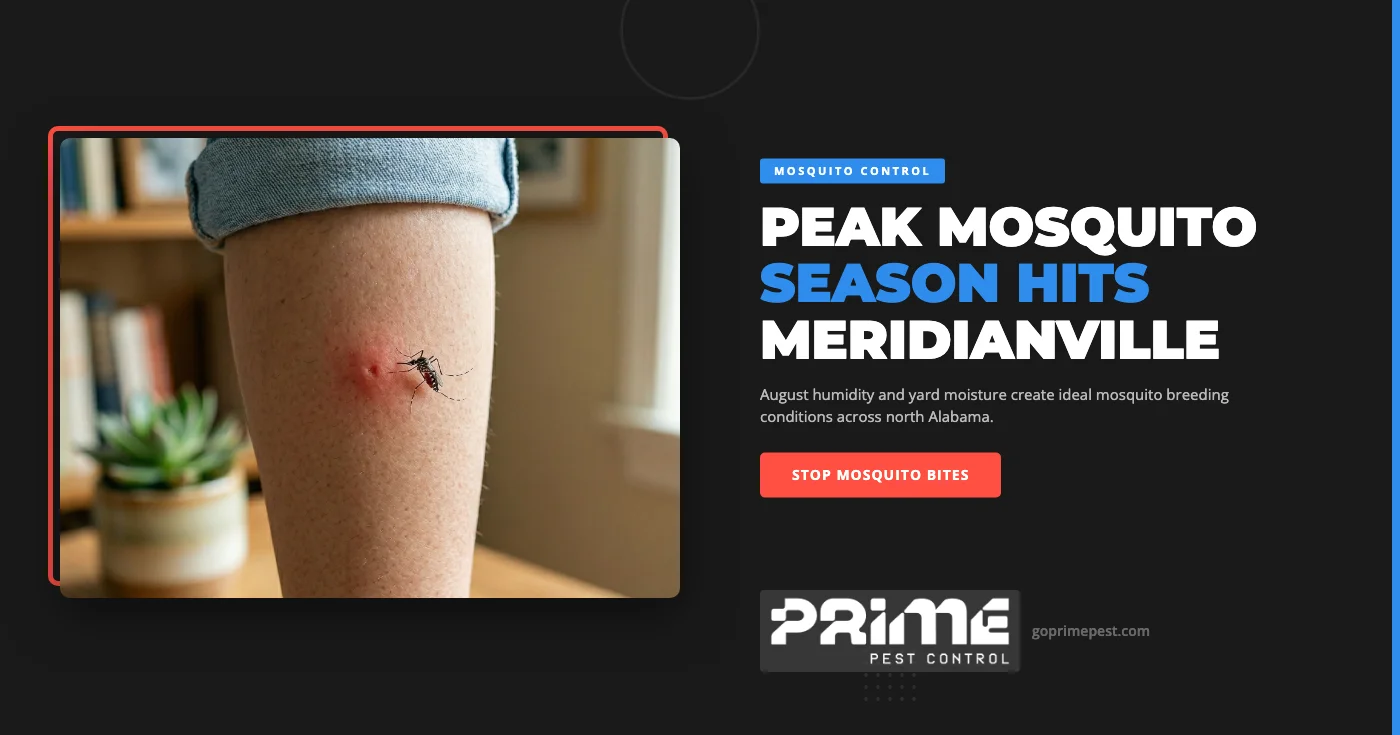
Mosquito Control in Meridianville, AL: Why August Is Peak Season for Bites
If you have spent an August evening on a porch in Meridianville, you know the pattern. The sun drops behind the ridge, the humidity settles in, and within minutes the mosquitoes find you. August is genuinely the worst month for mosquito pressure across North Alabama, and effective mosquito control Meridianville AL homeowners can count on this time of year means understanding peak-season biology, targeting the hidden water feeding it, and layering treatment on top of weekly prevention.
At Prime Pest Control, we run mosquito control across Meridianville, Hazel Green, Toney, and the northern half of Madison County every week from late April through October. Below is why the August peak hits our region so hard and how to keep your family enjoying the yard through the highest-pressure stretch of the season.
Why August Is Peak Mosquito Season in Meridianville, AL
Mosquito populations across North Alabama build gradually through spring and early summer, then reach their annual maximum in August. The small pool of females that survived winter has now produced generation after generation, doubling every seven to ten days since April. By early August the total feeding-age population on a typical Meridianville property is the highest it will be all year, and it stays elevated straight through Labor Day.
Weather is the primary driver. August in Meridianville brings daytime highs consistently in the low 90s, dew points holding in the upper 60s and low 70s, and afternoon thunderstorms that refill every low spot on the property every few days. Those conditions shorten the mosquito life cycle to roughly seven days from egg to biting adult — down from about ten days in early spring. Every water source we miss produces a fresh brood twice a month.
The other August-specific factor is behavioral. Late summer overlaps with back-to-school routines, fall sports practices, and evening yard time for Meridianville families. The window between 6 p.m. and 9 p.m. — when kids are running through the yard and parents finally sit down on the deck — is exactly when Culex mosquitoes take over from the daytime Aedes species and adult activity peaks. Peak season for bites and peak season for backyard living arrive at the same time.
Where Mosquitoes Breed on North Alabama Properties
Mosquitoes almost always breed closer to a Meridianville home than the homeowner realizes. When we walk a property for the first time, most families expect us to point at the creek line or the ditch across the road. Instead, we usually find the productive water sources within twenty feet of the back door.
The Alabama Cooperative Extension System notes that even a small amount of standing water is enough for a female mosquito to complete her egg-laying cycle. Around Meridianville, the sources we trace most often on August walkthroughs include:
- Clogged gutters: The single most common hidden breeding source on North Alabama homes. Debris slows the flow, water pools in the sagging low spots, and each run produces thousands of mosquitoes across the rest of the season.
- Corrugated downspout extensions: The ridged plastic tubing that carries water away from the foundation holds standing water in every corrugation, and the shaded interior is nearly ideal mosquito habitat.
- Plant saucers, kids' toys, and wading pools: Anything with a concave surface that catches rain becomes a nursery within a week. A bottle cap of water is enough for an Asian tiger female.
- Tarped grills, patio furniture covers, and boat covers: Any cover that develops a sag catches and holds water indefinitely.
- Tree holes and rotted stump cavities: Wooded lot lines around Meridianville hold tree holes that Aedes species specifically favor — a single cavity can produce an entire generation.
- French drains, catch basins, and stormwater inlets: When these silt in and stop draining freely, they become permanent breeding infrastructure.
- Detention pond edges and retention basins: The shallow margins hold water long after the center of the pond has cleared, and the surrounding vegetation gives adult mosquitoes ideal resting habitat.
- Rain barrels, ornamental fountains, and koi ponds: Permanent water features that go weeks between larvicide treatment are steady mosquito factories.
- Low spots along the property line: Especially on lots that grade toward the wooded edge or the Flint River tributaries, these hold water for days after every storm.
The pattern separating low-bite properties from high-bite ones is not the neighborhood — it is water discipline. Two Meridianville homes on the same street can have completely different mosquito loads depending on how many hidden water sources are producing broods on each lot.
Health Risks of Mosquitoes in the Huntsville Region
The August mosquito surge across the Huntsville region is a real public-health event, not just a comfort problem. The Alabama Department of Public Health tracks four established mosquito-borne illnesses in the state: West Nile virus (WNV), Eastern equine encephalitis (EEE), St. Louis encephalitis, and La Crosse encephalitis. WNV is by far the most reported in Madison County, and August through October is peak transmission every year.
According to the Alabama Department of Public Health, roughly 4 in 5 people infected with WNV never develop symptoms. About 1 in 5 develop fever, headache, body aches, joint pain, vomiting, or a rash typically 3 to 14 days after a bite. Less than 1 percent develop severe neuroinvasive illness — encephalitis or meningitis — which can be life-threatening. People over 60 and those with immune-compromising conditions face elevated risk. Cases have been reported from every public-health district in Alabama, including the North Alabama district that covers Meridianville.
Because there is no vaccine and no specific antiviral treatment for WNV in humans, prevention carries the entire load. Every reduction in adult mosquito density lowers the odds of a WNV-carrying female ever finding your household. Meridianville families with young children, older adults, or immunocompromised members should treat the August-to-October window as a real health consideration.
Professional Mosquito Control vs. DIY: What Works Better
Every August we get the same questions from new Meridianville customers about DIY tools. Most of them underperform badly at peak season, and one popular option is a category the CDC actively discourages.
Citronella candles, tiki torches, and clip-on repellents create a thin scent plume that dissipates within a few feet on any breeze. Ultrasonic devices and repellent wristbands do not deter biting females in field testing. Bug zappers kill enormous numbers of beneficial insects but few mosquitoes, which are drawn far more strongly to carbon dioxide than to UV light.
Big-box propane foggers knock down adult mosquitoes briefly, but the residual is short and the application rarely reaches the shaded undersides of leaves where mosquitoes rest during the day. Within a few hours the next wave arrives from the neighboring lot.
Homeowner misting systems are the costliest misstep. The CDC does not recommend residential misting systems because they spray on a timer without regard for actual mosquito presence, expose pollinators during their active daytime hours, and accelerate insecticide resistance.
Professional mosquito control Meridianville AL homeowners rely on looks nothing like a yard fogger. A trained technician walks the lot for breeding sources first, then applies an EPA-registered residual product with backpack mist blowers calibrated to coat the resting surfaces mosquitoes actually use — undersides of shrub leaves, mulch beds along the foundation, fence-line vegetation, and the shaded crawl beneath the deck. A properly applied barrier holds for 21 to 30 days in Alabama's summer humidity. For unremovable water, we layer in a Bti larvicide that targets larvae without harming fish, pollinators, or pets.
Prime Pest Control's Meridianville Mosquito Treatment Method
Our August program for a Meridianville home is structured around three principles: find the water first, treat the resting surfaces adults actually use, and time every application to minimize impact on pollinators. Every visit follows the same sequence.
- Full-property breeding-source walkthrough. Before we treat anything, our technician walks the lot and identifies every actual and potential breeding source — clogged gutters, low spots, plant saucers, corrugated downspouts, tree holes, tarped equipment, and stormwater infrastructure. We flag the ones you can drain in ten minutes and the ones we need to treat directly.
- Larvicide the water we cannot remove. Permanent water features, ornamental ponds, rain barrels, catch basins, and unremovable low spots get treated with Bti, a naturally occurring bacterial larvicide that kills larvae before they emerge. The product does not affect people, pets, fish, or beneficial insects.
- Targeted barrier on adult resting surfaces. Using calibrated backpack mist blowers, we apply an EPA-registered residual to the surfaces where adult mosquitoes rest between feedings — leaf undersides, mulch beds, foundation vegetation, fence lines, and the lower two to five feet of bordering tree canopy. We deliberately avoid blooming flowers.
- Pollinator-conscious timing. We schedule applications for early morning or late evening when bees and butterflies are not foraging. The pyrethroid we use has a short half-life on foliage relative to the protection window it delivers against mosquitoes.
- Return visits on a 21-to-30-day cycle. One treatment does not carry a property through mosquito season. During the August peak in Meridianville, we run most homes on a three-to-four-week rotation to keep the barrier fresh and catch new breeding sources between visits.
Once the application has dried — usually 30 to 60 minutes — treated surfaces are re-entry-approved per the product label. Our technicians flag completion and give every Meridianville household the exact window for their visit.
How to Keep Mosquitoes Out of Your Yard Between Treatments
A professional barrier treatment works best paired with weekly homeowner effort. The following steps make the biggest difference for Meridianville families between visits:
- Do the ten-minute weekly water walk. Every Saturday, walk the perimeter of the property and dump anything holding water — plant saucers, dog bowls, wading pools, tarped grills, coolers, wheelbarrows, kids' toys, and every kink in every downspout. The standard is dry, not "not much."
- Clean the gutters mid-season, not just in the fall. A clogged back-of-house gutter run is the single most common breeding source we trace on Meridianville inspections. Take an hour in August to clear the debris that has accumulated since spring.
- Trim vegetation along fence lines and shrub beds. Mosquitoes rest in shaded, humid vegetation between feedings. Opening airflow along the fence line and trimming shrubs off the ground reduces the daytime holding population.
- Mow slightly shorter through August. Tall grass provides adult mosquito harborage during the daytime. Keeping the lawn a half-inch shorter than usual through peak season measurably reduces resting habitat.
- Use EPA-registered personal repellents. The CDC recommends products containing DEET, picaridin, IR3535, or oil of lemon eucalyptus for anyone spending time outdoors during peak biting hours. Apply per the label, and reapply after swimming or heavy sweating.
- Dress with mosquitoes in mind at dawn and dusk. Long sleeves and long pants in light colors reduce bite exposure during the highest-risk windows. Loose-fitting clothing is better than tight — mosquitoes can bite through fabric pressed against skin.
- Repair every window and door screen. A single torn screen lets in enough mosquitoes to make a bedroom miserable.
- Set up a box fan on the porch. Mosquitoes are weak fliers. A moderate breeze from a box fan is often enough to make an outdoor sitting area effectively mosquito-free during peak evening hours.
Weekly water discipline, layered on top of professional mosquito control Meridianville AL households can count on, is the biggest lever a homeowner has through the August-to-October peak. Meridianville families we treat in early August consistently report lighter mosquito activity through Labor Day and the fall than those who wait until bites are intolerable.
If your porch is already unusable, if someone in the household has a condition that raises WNV concern, or if your lot backs onto a creek, retention pond, or wooded stretch of the Flint River corridor, we recommend a professional inspection sooner rather than later. Meridianville residents deserve straightforward answers and a treatment plan that fits the actual biology of their property — without exaggerated guarantees, and without treatments that expose kids, pets, or pollinators unnecessarily.