
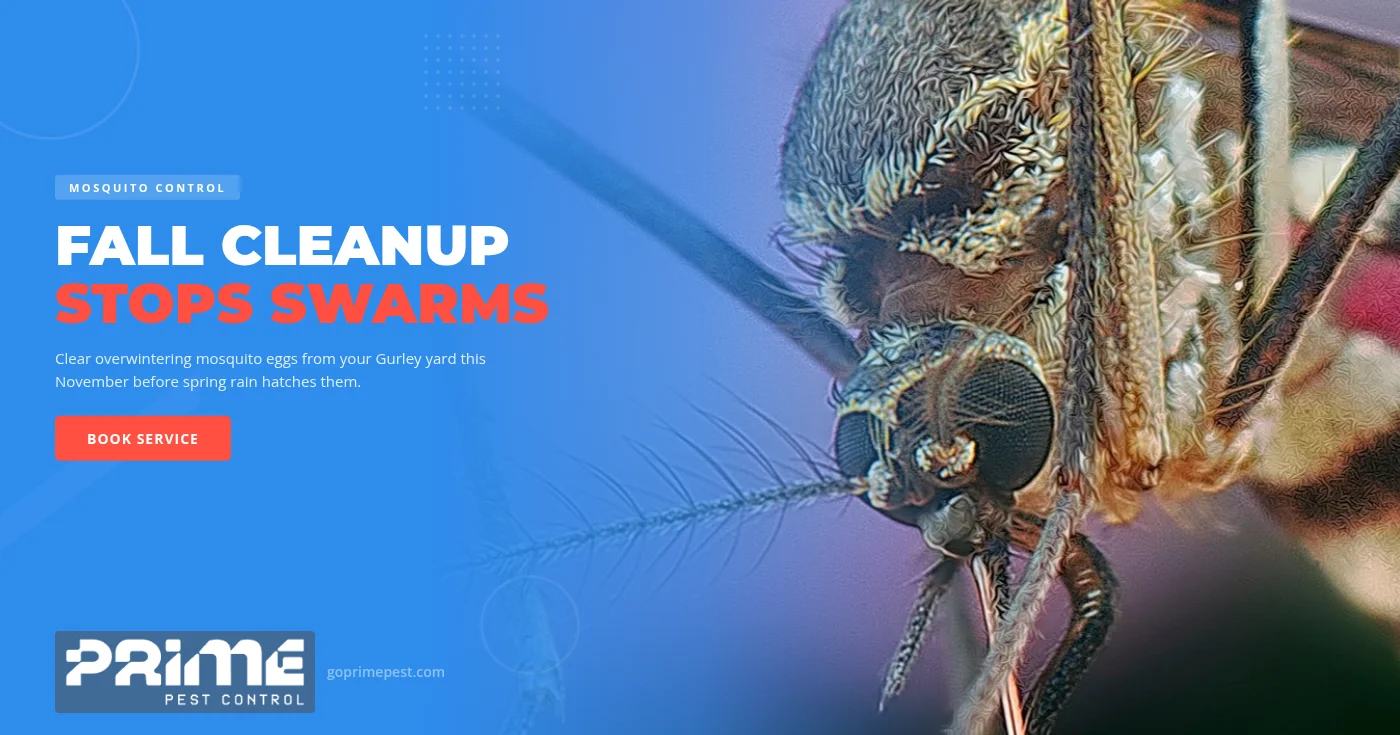
The first cold snap rolls through, the oaks start dropping leaves, and most of us stop thinking about mosquitoes until May. But fall mosquito control in Gurley, AL is one of the smartest yard projects you can take on this season. The mosquitoes that crash your spring cookouts don’t appear out of nowhere. Many of them are already in your yard right now, either as eggs glued inside a bucket or as adult females tucked away in a shed.
Here at Prime Pest Control, we spend a lot of time in yards across eastern Madison County, and November is when we watch next year’s mosquito problem quietly take shape. Leaves pack the gutters, toys and tarps collect rainwater, and warm afternoons still bring out a few biters. That’s why our mosquito control team treats late fall as the start of next season, not the end of this one.
In this post, we’ll cover where mosquitoes go when temperatures drop, the local features that raise your risk, a practical November cleanup checklist, what a professional treatment can and can’t do this time of year, and how to line up spring service early.
Why Mosquitoes Don’t Really Disappear When Fall Arrives in Gurley
It’s easy to assume the first frost wipes mosquitoes out. In reality, they slow down rather than vanish. Mosquitoes are cold-blooded, so their activity depends on the air around them. Most species turn sluggish somewhere around 50°F, though the exact point varies by species, and they perk right back up when the weather warms.
That’s exactly what a typical North Alabama November looks like. Highs often sit in the upper 50s to low 60s, lows dip into the mid-30s to low 40s, and the first frost usually arrives in late October or early November. Then a warm front pushes through, the afternoon climbs toward 70, and suddenly you’re swatting at your ankles on the porch. If you’ve ever wondered why mosquitoes still bite in November in north Alabama, those warm spells are the answer.
The bigger story happens out of sight. Some species leave behind eggs that wait for spring rain, while others survive as adult females hiding in sheltered spots. Either way, the population that greets you in April is largely built from what’s left in your yard right now.
There’s a health angle, too. The Alabama Department of Public Health tracks mosquito-borne illnesses such as West Nile virus and Eastern equine encephalitis, which has been reported in Alabama horses. Fewer mosquitoes around your home means less exposure for your family and animals.
Where Mosquito Eggs and Adults Hide Through a North Alabama Winter
Two groups of mosquitoes do most of the biting around Madison County, and they get through winter in very different ways.
Asian tiger mosquitoes: eggs waiting for spring rain
The Asian tiger mosquito is the black-and-white daytime biter most of us know too well. According to the CDC’s overview of the Aedes mosquito life cycle, females lay eggs on the inside walls of containers just above the waterline. Those eggs cling tightly and can survive dry, cold conditions for months. When spring rain refills the container and floods them, they hatch.
That’s the heart of Asian tiger mosquito prevention. These mosquitoes don’t need a pond; a bottle cap of water can be enough. In warm weather they may go from egg to biting adult in roughly a week, depending on temperature. Overwintering mosquito eggs are tiny and easy to miss, so an empty bucket that looks clean may still be loaded.
Culex mosquitoes: adult females in hiding
The southern house mosquito and other Culex species take a different route. Mated adult females find protected spots and wait out the cold in crawl spaces, sheds, culverts, hollow logs, woodpiles and garages. On a mild winter day, some wake up and move around, which is why you might spot one in the garage in January.
Knowing both strategies tells you where to focus: containers that hold eggs, and sheltered places that hold adults.
Gurley’s Creeks, Low Spots and Wooded Lots: Local Risk Factors to Know
Gurley sits in eastern Madison County along US-72, in a valley at the foot of the Appalachian foothills. It’s beautiful country, and it offers nearly everything mosquitoes like.
- Creeks and drainage: The Flint River watershed and the smaller creeks winding through the valley keep ground damp, and backwater pools linger after storms.
- Low spots and ditches: After heavy rain, roadside ditches, culverts and the low corners of yards can hold water for days.
- Wooded lots: Trees mean leaf litter, shade and tree holes that collect rain, which are ideal for egg-laying females and resting adults.
- Rural property: Old tires, buckets, wheelbarrows, tarps and livestock troughs are some of the most productive breeding spots we find.
Fall adds another layer. Most leaves come down now, settling into gutters, drains and low spots, slowing drainage and creating soggy pockets that hold moisture all winter.
If your property backs up to woods or tall grass, mosquitoes aren’t the only concern. Those shady, humid edges are ideal for ticks, which stay active on warm winter days too. Pairing your mosquito plan with tick control makes sense for families and pets who spend time along tree lines. The good news is that a focused weekend of work reduces most of these risks, and that’s where mosquito control in Gurley really starts.
A November Yard Cleanup Checklist: Gutters, Containers, Leaf Piles and Drainage
Think of this as a mosquito breeding sites fall cleanup: one big push in November, followed by quick checks after rain. The Alabama Cooperative Extension System and the CDC share the same core advice: tip, toss, scrub and cover anything that holds water.
Gutters and downspouts
Clogged gutters after leaf fall are a classic mosquito breeding spot, creating a shallow, nutrient-rich pool right along your roofline.
- Clear gutters once most leaves have fallen, and again after the last big drop.
- Flush downspouts and make sure they drain away from the foundation.
- Consider gutter guards if your lot is heavily wooded.
Containers: tip, toss and scrub
This is how to get rid of mosquito eggs before winter in Alabama. Dumping water isn’t enough, because eggs cling to the inside walls.
- Empty and scrub buckets, planter saucers and bird baths with a stiff brush.
- Flip or store wheelbarrows, kiddie pools, toys and empty pots.
- Drill drainage holes in tire swings and bins, or get rid of old tires.
- Pull tarps tight so they don’t form puddles.
- Change bird bath and pet water every few days.
Leaf piles and drainage
Leaf piles hold moisture and give adults a sheltered resting spot. Bag leaves, mulch them into the lawn, or compost them well away from the house. Trim dense shrubs so sunlight reaches the soil, fill low spots where you can, and clear debris from ditches and culverts on your property.
What a Professional Fall Mosquito Treatment Covers and Why Timing Matters
We want to be upfront about what spraying can and can’t do this time of year. A fall barrier treatment mainly targets adult mosquitoes that are still active and the shaded spots where they rest. It does very little to eggs sitting dry inside a container. That’s why your cleanup and a professional visit work best together.
Here at Prime Pest Control, a fall mosquito yard treatment in Alabama typically includes:
- An inspection to find breeding sites you may have missed, like hidden containers, clogged drains and tree holes.
- Targeted treatment of shrubs, under-deck areas, fence lines and dense vegetation where adults rest.
- Our Prime Yard Shield approach, covering the yard from front curb to back fence so we hit the source, not just the symptoms.
- Practical recommendations for drainage and container fixes specific to your property.
Timing matters because product labels limit when and how applications can be made, and mosquitoes only contact treated surfaces when they’re moving. Treating ahead of a warm stretch, rather than during a hard freeze, gives the application its best chance to work.
Fall is also when other pests head indoors. Spiders, cockroaches and earwigs top our winter watch list, and general pest control with perimeter, eave and garage treatments helps keep them outside while your mosquito plan handles the yard.
Planning Ahead: Starting Spring Mosquito Service Before the First Warm Week
The best time to book spring mosquito service is before you need it. Many North Alabama homeowners start treatments in March or April, but the right date depends on the weather. An early warm stretch can trigger hatching weeks ahead of schedule, and by the time the first swarm reaches your patio, the next generation is already developing nearby.
- November: Finish your yard cleanup and schedule a fall treatment if mosquitoes are still active on warm days.
- December through February: Check containers after big rains and keep gutters clear of late leaves.
- Late winter: Lock in recurring spring service so your first visit lands before the first warm week.
- Spring through fall: Keep the weekly tip-and-toss habit while regular treatments handle the adults.
Recurring service is where the real difference shows. One treatment knocks back the adults present that day, but mosquitoes keep emerging all season, so consistent visits keep steady pressure on the population.
At Prime Pest Control, we also make it easy to cover more than mosquitoes. Our bundle combines mosquito, flea and tick, rodent and general pest control for a flat rate of $89 a month, and military discounts are available.
Frequently Asked Questions About Fall Mosquito Control in Gurley
Do mosquitoes die in winter in Alabama?
Not entirely. Many adults die off as temperatures fall, but Asian tiger mosquitoes survive as eggs and Culex mosquitoes survive as adult females in sheltered places. On warm winter days, a few may become active again.
Where do mosquitoes go in winter in Gurley, AL?
Adults tuck into crawl spaces, sheds, garages, culverts, hollow logs and woodpiles. Eggs stay stuck inside buckets, tires, planters, gutters and tree holes, waiting for spring rain to flood them.
Can mosquito eggs survive freezing temperatures?
Many can. Asian tiger mosquito eggs tolerate cold, dry conditions for months, although long hard freezes may kill some. Scrubbing or removing containers is far more reliable than counting on the weather.
Are mosquito treatments pet-friendly?
When products are applied according to the label, most families can keep enjoying the yard with a few simple precautions. We generally ask that pets and kids stay off treated areas until they’ve dried, and we avoid treating flowering plants where pollinators feed. Ask your technician about any specific concerns.
Book Fall Mosquito Control in Gurley, AL With Prime Pest Control
A little work in November pays off all next spring. Clear the gutters, scrub the containers, handle the leaf piles and fix the low spots, and you’ll remove much of what next year’s mosquitoes depend on. Add professional fall mosquito control in Gurley, AL and a recurring plan that starts before the first warm week, and you’ll be in a much stronger position when the weather turns.
Prime Pest Control has been protecting homes across the Huntsville area and surrounding Madison County communities since 2021. We’re proud of our 4.9-star rating from more than 1,000 Google reviews and of being rated the best pest control company in Huntsville in 2024. When you’re ready for a yard that’s prepared for spring, contact our team to schedule your visit.
Why Should I Schedule Mosquito Control Before Spring Arrives?
Because the mosquitoes that ruin spring evenings are already in your yard right now. We see it every fall: eggs stuck inside containers, adults tucked into sheds, and leaf-clogged gutters holding water. Getting ahead of them before the weather warms is far easier than chasing swarms in May.
Here’s how we help:
- Thorough inspections that pinpoint breeding sites and resting areas around your property.
- Full-yard coverage with our Prime Yard Shield, from front curb to back fence.
- Recurring seasonal service that keeps steady pressure on mosquito populations from spring through fall.
- Practical advice on drainage, gutters and containers so your yard stays less inviting between visits.
We also offer a bundle that combines mosquito, flea and tick, rodent and general pest control for a flat rate of $89 a month, and military discounts are available. When you sign up for recurring pest service, your initial general pest service is $49 and includes one free mosquito or flea and tick treatment.
Since 2021, we’ve earned a 4.9-star rating from more than 1,000 Google reviews, and we were rated the best pest control company in Huntsville in 2024. Learn more about our mosquito control services or reach out to our team to get on the schedule before the first warm week.


