
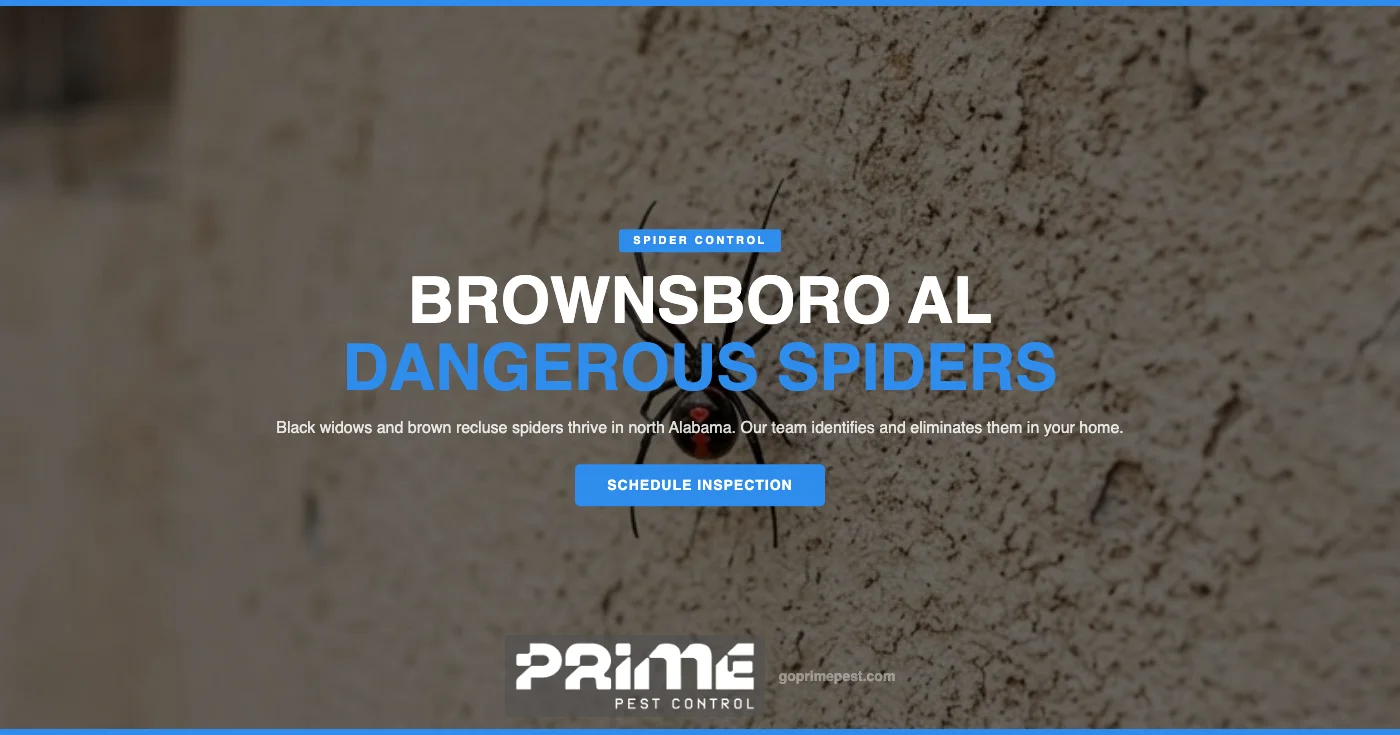
Of all the pest calls we field in Brownsboro, AL each summer, the most anxious ones are about spiders — and the question is almost always the same: is it a black widow, is it a brown recluse, and is everyone alright. Most spiders our team sees in Madison County homes are harmless, but North Alabama is home to both venomous species, both become noticeably more active from late May through September, and recognizing the difference is the first step toward effective spider control in Brownsboro, AL.
Brownsboro sits in the Flint River corridor east of Huntsville, where wooded acreage, older outbuildings, and brick-and-crawl-space construction give dangerous spiders exactly the harborage they prefer. Humid summers, the surge of prey insects after every storm, and the abundance of undisturbed garages, sheds, and storage areas push activity to its peak right now.
Black widows and brown recluses live in our area year-round. What changes in summer is the activity level, the population size, and the likelihood that a homeowner crosses paths with one. Three local conditions drive the spike.
First, prey insects explode. Summer thunderstorms push ants, beetles, gnats, and small moths up against foundations and into garages and crawl spaces. Both species are predators, and predator populations follow prey.
Second, undisturbed harborage stays warm and dry. Attics, storage rooms, and detached sheds give brown recluses the hot, dry microclimate they prefer, while black widows settle into the cooler pockets of crawl spaces, woodpiles, and outbuildings.
Third, summer is when humans interact with these zones most often. We pull holiday boxes from attic storage, dig into garden sheds, stack and move firewood, and reach into rarely-opened cabinets. The vast majority of bites in our region happen when a spider already living in a quiet spot gets pressed against skin during one of these routine activities.
The female black widow is one of the most recognizable spiders in North America once you know what to look for. According to the Alabama Cooperative Extension System, female black widows reach up to roughly 1½ inches in length including the legs and display a jet-black, globe-shaped abdomen with a distinctive red hourglass pattern on the underside.
When we are confirming a black widow ID on a Brownsboro property, we look for the following:
Males are smaller, lighter brown, and rarely a medical concern. The adult female is the spider that matters.
Brown recluse identification trips up more North Alabama homeowners than any other spider question we field. Nearly every brown spider gets nicknamed a "recluse," and the vast majority are not. Three identifiers, used together, give a reliable ID.
Size and color. Adult brown recluses are about the size of a quarter including legs — roughly 3/8 inch in body length. They range from light tan to medium brown and have a uniform, undecorated abdomen. If the abdomen has stripes, bands, dots, or any pattern, it is not a recluse.
Violin marking on the cephalothorax. The recluse has a darker violin-shaped marking on the head and thorax, with the neck of the violin pointing back toward the abdomen. Some harmless species have markings that look superficially similar at a glance, which is why the violin alone is not enough.
Six eyes in three pairs. The definitive identifier. Most spiders have eight eyes; the brown recluse has six, arranged in three pairs across the front of the head. With a flashlight and the spider contained behind glass, the eye arrangement is the most reliable way to confirm a recluse.
Common look-alikes our technicians have ruled out on Brownsboro service calls include:
If you are not sure, do not pick the spider up. Capture it under a glass, photograph it from above, and send the image to our team.
The two species live in very different parts of a typical home, and prevention only works when it targets the right zones.
Black widows favor outdoor and semi-outdoor spaces. On Brownsboro properties, we routinely find them in:
Brown recluses prefer dry, dark, undisturbed indoor spaces. On the same properties, we find them in:
Anywhere a spider can settle in for weeks undisturbed, and where prey insects pass through, is a candidate. Brownsboro's mix of wooded lots, older outbuildings, and brick crawl-space homes provides plenty of both.
Both species can deliver medically significant bites, though both bite far less often than their reputation suggests. Bites almost always occur when the spider is pressed against skin — reaching into a storage box, pulling on a stored boot, rolling onto a spider in bedding.
Black widow bites deliver a neurotoxin. The CDC's venomous spider guidance describes muscle pain, cramping, sweating, and abdominal stiffness developing within an hour. The bite itself may feel like a sharp pinprick or may not be noticed at all. Children, older adults, and anyone with underlying health conditions should be evaluated immediately.
Brown recluse bites are slower to declare themselves. The Cleveland Clinic's brown recluse guidance notes bites are often painless at first, with the site reddening over several hours and sometimes progressing to a blister, open ulcer, or darker, necrotic patch over the following days. Fever, chills, nausea, or joint pain can follow.
If a black widow or brown recluse bite is suspected:
Prevention is where Brownsboro homeowners get the biggest return on effort. A weekend of focused attention on the right zones reduces both species' opportunities dramatically.
If you have confirmed (or strongly suspect) a black widow or brown recluse on your Brownsboro property, professional treatment is the right call. The same goes for properties where multiple sightings, recurring webs, or visible egg sacs suggest the population has crossed from incidental to established.
Our approach to spider control on Brownsboro properties is built around three ideas: confirm the species and the harborage, eliminate the population in the actual zones where it lives, and reduce the conditions that brought them in. A typical service visit includes:
Yes. The southern black widow is native to North Alabama and lives across Madison County, including Brownsboro. We find them most often in outdoor and semi-outdoor harborage — water meter boxes, woodpiles, crawl space corners, sheds, and under rarely-moved patio furniture. Indoor sightings are far less common but do occur.
Three identifiers used together: a tan-to-medium-brown body about the size of a quarter including legs, a darker violin-shaped marking on the cephalothorax with the neck pointing toward the abdomen, and six eyes arranged in three pairs. If the spider has stripes or patterning on the abdomen, eight eyes, or hairy legs and a body larger than a quarter, it is not a recluse.
Wash the bite with soap and water, apply a cool compress, elevate the area, and seek medical evaluation — particularly for children, older adults, and anyone with underlying health conditions. Bring or photograph the spider if you can. Watch the bite for 72 hours for spreading redness, blistering, dark or necrotic tissue, fever, muscle cramping, or systemic symptoms.
Late spring and early summer are the most effective times. Treating before populations peak is far easier than chasing established populations through the heat of August. If you have confirmed a black widow or brown recluse at any point in the year, professional inspection should not wait.
Dangerous spider activity is part of life in Brownsboro, AL, but with the right identification, prevention steps, and a treatment plan tuned to North Alabama harborage patterns, a black widow in the woodpile or a recluse in the attic does not have to become a bite. Contact Prime Pest Control to schedule a spider inspection. With a 4.9-star rating from more than 2,574 customers across the Huntsville and Madison County area, we are committed to protecting the homes in our community — one inspection at a time.