
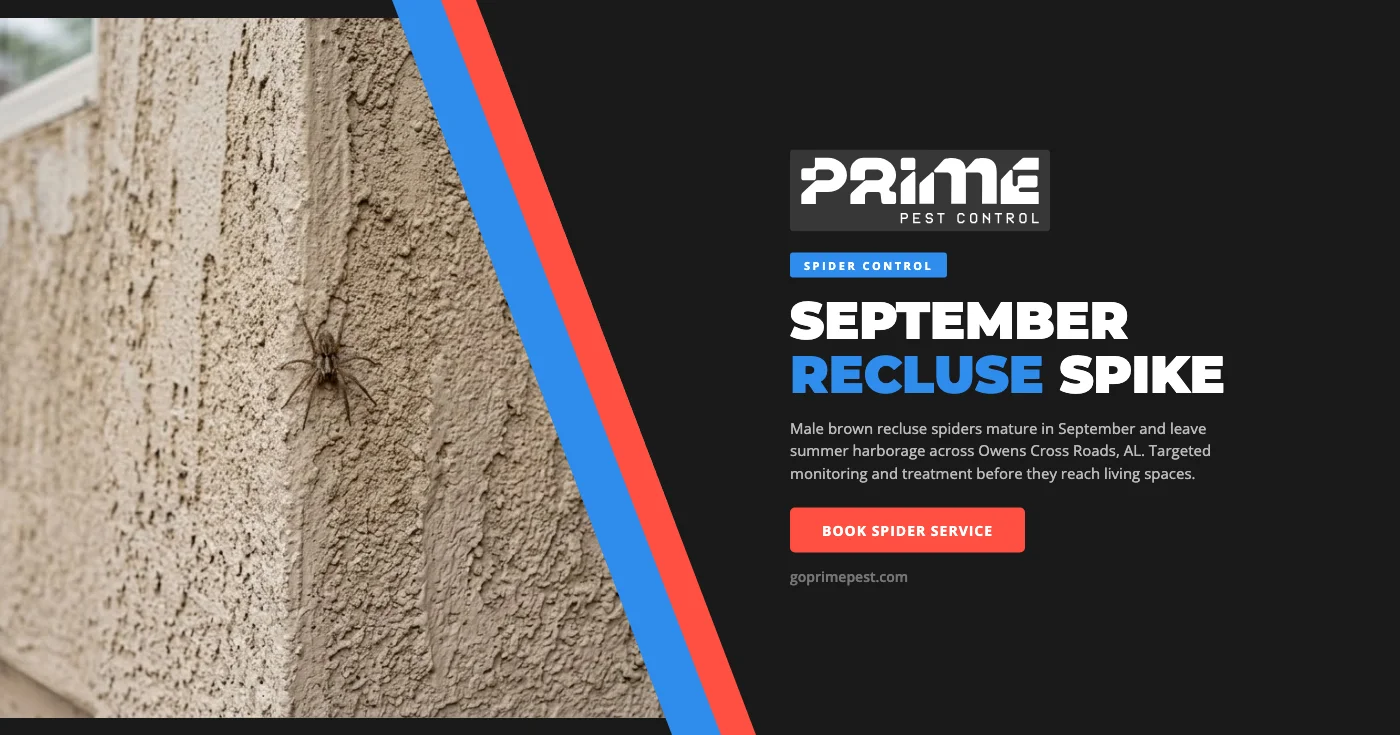
If you have walked through your Owens Cross Roads garage or basement in the last week and spotted a small brown spider that seemed to move for cover with unusual purpose, September is the month that answers the question. Brown recluse spiders that spent the summer tucked into wall voids, storage boxes, and undisturbed corners are on the move — and the encounter rate in Owens Cross Roads homes climbs sharply from Labor Day through the first hard frost.
At Prime Pest Control, we handle spider control across Owens Cross Roads, Hampton Cove, and the wider Madison County corridor every fall. Below is why September sightings spike in North Alabama, how to tell a brown recluse from the wolf spider or cellar spider you may actually be looking at, and how our team clears an established infestation without pushing the population into rooms your household is using.
Why Brown Recluse Spiders Are More Active in September in North Alabama
Brown recluse spiders are shy, sedentary animals that spend weeks at a time tucked into a single cavity. What changes in September for Owens Cross Roads homes is not that a new population arrives from outside — it is that the resident population starts moving around inside the house.
Two biological signals drive the shift. First, male brown recluses mature to reproductive age in late summer and leave the sheltered spot they grew up in to search for females. That search takes them across floors, along baseboards, and into rooms they were never seen in during June or July. Second, prey activity peaks as other pests — silverfish, small crickets, cockroach nymphs — become active in the same corners of the home. A hungry brown recluse leaves its hiding spot to hunt at night, and the odds of an Owens Cross Roads homeowner seeing one in the shower or on a bedroom wall rise substantially.
According to the Alabama Cooperative Extension System, the brown recluse is present throughout Alabama but "more commonly found in the state's northern half" — a range that includes every neighborhood in Owens Cross Roads, Big Cove, and the rural stretches out toward Gurley and New Market. The extension also notes that the species remains active between 45 and 110 degrees, which in North Alabama means a September–October window in which outdoor evenings are cool enough to push activity indoors but nothing has yet forced the colony into dormancy. That specific overlap is what produces the sightings-spike we field on the phone every fall.
How to Identify a Brown Recluse Spider vs. Common House Spiders
Most spiders reported to us as brown recluses in Owens Cross Roads are not brown recluses. Correct identification matters — a wolf spider or cellar spider is a nuisance the household can generally tolerate, whereas a confirmed brown recluse population inside living areas is worth calling us about. Two features resolve almost every ID question: the eyes and the body pattern.
Six eyes in three pairs. Almost every common house spider has eight eyes arranged in two rows. The brown recluse has six, arranged in three pairs — one pair front-and-center and two pairs flanking on either side, with a small gap between each pair. Under a magnifying glass this is unmistakable, and it is the single most reliable identification feature.
A uniform body, not a patterned one. The brown recluse is light tan to medium brown, uniform in color, with no bands, stripes, or spots on the abdomen or legs. If the spider you are looking at has a fuzzy body, banded legs, a bulbous marbled abdomen, or a bright pattern of any kind, it is not a brown recluse. The much-discussed "violin" marking on the front body segment is real but hard to see on a live spider — do not rely on it as your only check.
Size, posture, and behavior. A mature brown recluse is a quarter- to half-inch body with a leg span up to about an inch, notably smaller than the wolf spiders many Owens Cross Roads homeowners find in garages. Brown recluses hold their legs close to the body and move in short bursts before freezing; wolf spiders sprint openly across floors, and cellar spiders shake their web when disturbed. If the spider on your wall is thumbnail-sized with legs sticking out at all angles, it is far more likely a wolf spider or a common house spider than a brown recluse.
Common Entry Points Spiders Use in Owens Cross Roads Homes
Brown recluses do not have to invade — most established populations in Owens Cross Roads homes have been present for months or years before anyone notices. Understanding where they hide and how they get in and around is the first step in reducing the encounter rate without accidentally spreading the population into new rooms.
On our Owens Cross Roads inspections we most often find brown recluse harborage in the following places:
- Cardboard boxes in attics and garages. Corrugated cardboard is an ideal harborage — dry, insulated, and undisturbed for months. Moving boxes stored since a recent move are the number one hotspot in newer Owens Cross Roads builds.
- Under folded linens and stored clothing. Closets and dresser drawers that hold seasonal clothing, guest linens, or holiday decorations often contain spiders that have not been disturbed since spring.
- Behind picture frames and hanging mirrors. The narrow gap between a large frame and the wall is a favorite daytime resting spot, and one of the reasons homeowners suddenly see a spider drop onto a bed or couch.
- Utility rooms with a furnace or water heater. Warm, dry, low-traffic — a textbook brown recluse habitat. Basements and mechanical rooms in older Owens Cross Roads homes show consistent harborage year after year.
- Under furniture that never gets moved. The couch that has been in the same living-room position for three years, the guest-room bed frame, the recliner in the office. Undisturbed floor space and a bit of dust are what brown recluses look for.
- Cluttered garages and outbuildings. Stacked boxes, coiled hoses, and wood scraps behind a workbench give a population room to grow before anyone realizes it is there.
Common entry paths from outdoors include gaps around exterior doors, garage-door thresholds that no longer seal, dryer-vent flaps, foundation cracks, and the point where utility lines penetrate the wall. In the brick-veneer construction common across Owens Cross Roads, weep holes give year-round access to the wall void, and any interruption in the sill flashing gives spiders a clear path from wall cavity to interior room.
Health Risks of a Brown Recluse Bite
Brown recluses are shy and rarely bite unless pressed against skin — typically inside a shoe, a glove, or a fold of clothing that has been in an undisturbed location. Most bites in Owens Cross Roads are single, defensive, and heal without incident. A meaningful minority do not, and the medical response is worth knowing before the fact rather than during it.
According to the Centers for Disease Control and Prevention, the venom of the brown recluse "can cause a severe lesion by destroying skin tissue," which is why professional medical evaluation is the standard of care rather than watchful waiting. The initial sensation is typically a mild sting followed by localized pain and, over the next hours, a small white blister at the bite site.
Bites are graded roughly into three categories. Most heal on their own over about three weeks with local wound care. A subset develops a slow-expanding necrotic lesion — the ring of dark tissue that dominates internet images of the species. A small percentage produce a systemic reaction called loxoscelism, with fever, chills, nausea, and, rarely, hemolytic anemia. The systemic form is more common in children than in adults.
Medical response worth committing to memory now:
- Wash the bite area with soap and water as soon as possible.
- Apply a cold compress to reduce swelling and slow venom spread.
- Elevate the affected limb where possible.
- Photograph the spider if it is dead or capture it in a jar without touching it — species confirmation changes the treatment path a physician chooses.
- Seek professional medical evaluation if the bite site develops a blister, changes color, spreads beyond a quarter, or is accompanied by fever, muscle aches, or hives away from the bite.
- Call 911 or go to an emergency room for throat swelling, breathing difficulty, or loss of consciousness — anaphylaxis to insect venom does occasionally involve spider bites and requires immediate epinephrine.
Households with small children, elderly members, or anyone immunocompromised should treat a confirmed brown recluse indoors as a whole-household well-being issue rather than a single-spider inconvenience.
What to Do If You Spot a Brown Recluse in Your Home
The first spider is almost never the last. Brown recluse populations grow slowly — a female produces about five egg sacs in her lifetime, each carrying roughly 40 to 50 spiderlings — but by the time a homeowner sees one on the wall, several dozen are typically present in wall voids, storage boxes, and undisturbed corners nearby. Response steps that reduce risk without stirring the population:
Do not spray a general household aerosol. Over-the-counter sprays scatter surface spiders into new rooms without reaching the harborage in the wall cavity or under the furniture. The result is more visible spiders in more rooms, not fewer.
Do not tear out clutter yet. The instinct to immediately empty the attic or clear every storage box is understandable but counterproductive. Disturbing harborage before treatment pushes spiders into the living space. Calm inspection first, then targeted cleanup after treatment.
Do install glue-board monitors. Placed flat against baseboards and along the wall behind furniture, glue boards give us a population map without any pesticide use. Two weeks of monitors tell us whether the household is dealing with three spiders or three hundred.
Do shake out shoes, gloves, and stored clothing before wearing them. Almost every bite we hear about from Owens Cross Roads originates from a spider that was already inside a piece of clothing when the person put it on.
Do check under bedding and behind picture frames before going to sleep. A brief visual inspection of the bed and headboard becomes second nature during peak activity and eliminates the highest-consequence bite risk.
Do call a licensed professional. Brown recluse populations in an Owens Cross Roads home are the pest problem for which the DIY-versus-professional math tilts most sharply toward professional treatment. Missed harborage points are the difference between a real solution and a temporary knock-down.
How Prime Pest Control Eliminates Spider Infestations in Owens Cross Roads
Our brown recluse program for Owens Cross Roads is built around three ideas: locate the harborage before treating, treat every part of the harborage on the same visit, and monitor for population recovery so the household is not chasing the same problem next fall.
- Full interior and exterior inspection. Our technician walks every room, opens every mechanical space, and flags every point of harborage. Glue-board monitors go down in the corners with the highest suspected activity. The exterior inspection covers weep holes, sill flashing, garage-door sweeps, dryer vents, and any foundation gap wide enough for a spider to enter.
- Targeted application in harborage, not on open floors. We treat the wall voids, plumbing chases, and utility penetrations where the population actually lives with an insecticidal dust that reaches the deep hiding spots general sprays never touch. Baseboards and behind large furniture receive a residual crack-and-crevice treatment. Open floor space stays untreated because that is not where the spiders spend their time.
- Physical exclusion. After treatment, our technician walks the exterior with the homeowner and identifies the small handful of exclusion steps that produce the biggest reduction in next-year pressure: replacing garage-door thresholds, sealing dryer vents, installing door sweeps on interior doors that separate the garage from living space, and closing off attic penetrations.
- Monitor and re-treat. Glue boards stay in place between visits so both the homeowner and our team can see the population trajectory over the following weeks. A follow-up visit three to four weeks in catches any second-generation spiders emerging from egg sacs that were present at the initial treatment.
- Documentation and warranty. Every Owens Cross Roads household we serve gets a written record of what we treated, where, and with what product. If activity returns within our warranty window, we re-treat at no additional charge — because the goal is a genuinely quiet home, not a repeating service line.
Fall in Owens Cross Roads is the moment to act. Populations are as visible as they will be all year, egg sacs from the summer are still hatching, and every mated female that overwinters in a wall void becomes the seed of next spring's colony. If you have seen one brown recluse in a living area, if a shed skin has turned up in an attic box, or if the guest bedroom has felt off since the weather turned, the earlier we get eyes on the property, the more manageable the whole population becomes.
We serve Owens Cross Roads, Hampton Cove, Big Cove, Meridianville, Toney, and the broader Huntsville area from our Madison location. A brown recluse call in September keeps the peace of mind of your household intact through fall, winter, and the following spring's egg-hatch cycle.