
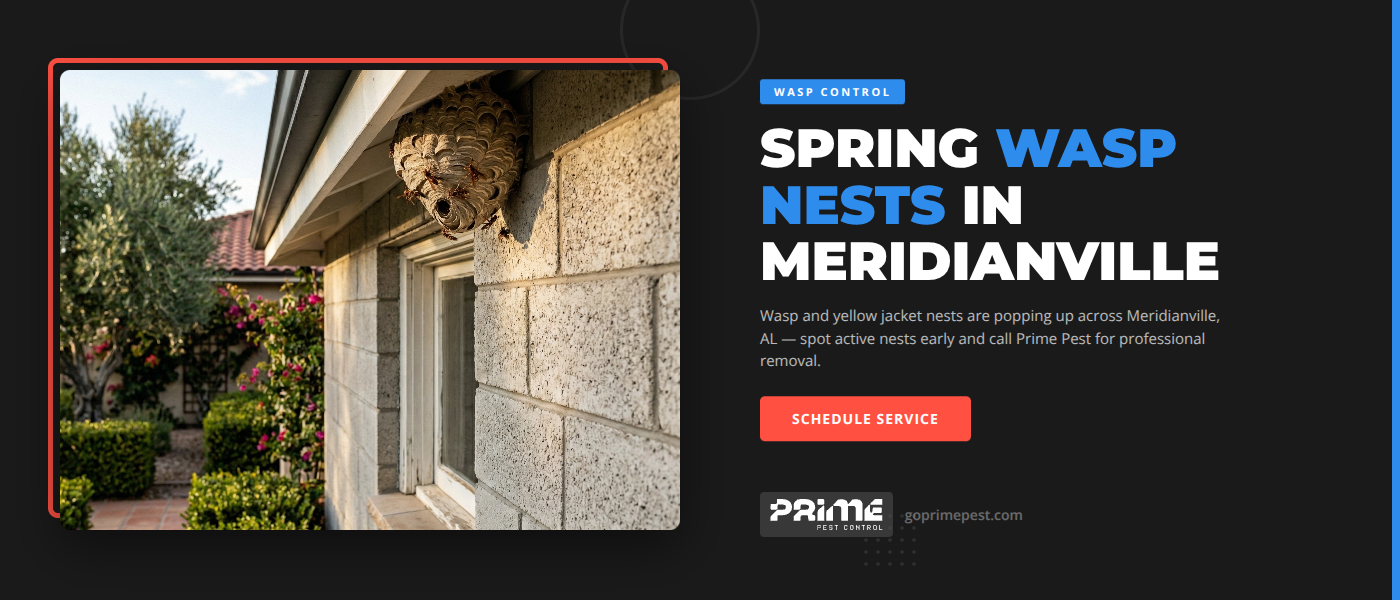
Spring in Meridianville means warm afternoons, blooming dogwoods, and the unmistakable hum of paper wasps cruising the eaves of a back porch. After a mild Tennessee Valley winter, overwintered queens are emerging from woodpiles, attic corners, and tree cavities — and they are scouting for somewhere to build. If you have already spotted a papery nest under your soffit, you are not imagining it. Effective wasp control in Meridianville, AL starts with understanding that spring is when stinging-insect activity ramps up across North Alabama, and the choices you make over the next few weeks decide whether you spend the summer dodging stings or enjoying your backyard.
At Prime Pest Control, we get called out to neighborhoods from Meridianville through Hazel Green and New Market every spring — sometimes for a single starter nest the size of a quarter, sometimes for a softball-sized colony tucked into a grill cover. Below is what is driving the seasonal surge and when professional wasp control is the right call.
The annual cycle of every social wasp colony in North Alabama is tied directly to temperature. According to the University of Maryland Extension, mated queens are the only colony members that survive winter, sheltering in protected spaces while the rest of the workers die off. Once daytime temperatures climb into the 60s — typically mid-March in Madison County — those queens emerge, feed on early-season nectar, and begin scouting nest sites.
A single queen builds a tiny starter nest with a handful of cells. Within four to six weeks she has raised her first generation of workers, and the colony scales fast from there. By July, what started as a quarter-sized hexagon under a gutter can host one hundred to three hundred paper wasps. Yellow jacket colonies grow faster still, often reaching several thousand workers by late summer.
Meridianville sits in a favorable corridor for stinging insects. Our humid subtropical climate lets more queens survive than in colder regions, and the Alabama Cooperative Extension System has documented warm-winter years in which entire colonies overwintered and produced the oversized "super nests" Alabama is occasionally known for. Even in a normal year, that means more queens, more nests, and higher sting risk than in many other parts of the country.
Not every black-and-yellow flier buzzing your patio is the same insect, and species matters because each one nests differently and reacts differently to disturbance. Around Meridianville we most often deal with four:
Knowing which one you are looking at changes the response. A red wasp colony on a back porch is a different problem from a ground yellow jacket nest near a swing set.
Spring queens look for two things in a nest site: shelter from wind and rain, and a structure they can attach to or burrow into. On Meridianville homes, that translates to a predictable short list of high-risk locations.
Paper wasps and red wasps favor soffits, fascia boards, and the underside of gutters; porch and deck ceilings; the insides of grill covers, mailboxes, and door wreaths; storage shed corners and the underside of patio furniture; and outdoor light fixtures or electrical meter boxes.
Yellow jackets prefer abandoned mole or rodent burrows in the lawn (often invisible until you mow over them), gaps in foundation walls or brick weep holes, attic and wall voids accessed through unsealed soffit vents, root systems of large trees, and HVAC condensate lines or crawlspace openings.
Bald-faced hornets typically build fifteen to thirty feet up in trees, in the eaves of barns and detached garages, and inside dense shrubs and ornamental tree canopies.
A walkaround inspection in late March or April — looking for chewed-paper material, hovering single wasps, or small disc-shaped starter nests — is one of the most useful fifteen minutes you can spend before summer.
The internet is full of advice about knocking down wasp nests with a broom, soaking them with dish soap, or burning them out at night. We recommend against every one of these approaches, and not because we want the service call. Here is what actually happens when DIY removal goes wrong.
Defensive swarming and multiple stings. Paper wasps and yellow jackets release alarm pheromones when their nest is threatened, and within seconds dozens of workers fly toward the disturbance. Unlike honey bees, they can sting repeatedly. The Centers for Disease Control flags stinging insects as a leading cause of work-related deaths from animals in the United States, almost entirely due to anaphylactic reactions.
Ladder falls. Most homeowner injuries we hear about from DIY wasp removal are not from stings — they are from people jumping or falling off a ladder when wasps boil out of a nest.
Hidden nest size and wrong product choice. What looks like a small nest under a soffit is often the visible tip of a larger structure inside the wall void behind it, and spraying the entrance can drive the colony deeper into the home. Aerosol wasp sprays also cannot penetrate ground burrows or insulated wall voids. Without professional formulations and application equipment, DIY attempts often anger the colony without ever eliminating it.
Some situations almost always justify a professional visit. Get in touch with our team right away if any of these apply:
Even smaller paper wasp nests in low-traffic locations are worth a quick call, because what looks like a five-cell starter nest in April is often a hundred-cell colony by July.
Every Meridianville property is a little different, but our approach to stinging-insect treatment follows a consistent sequence we have refined over years of service calls across North Alabama.
1. Identification and inspection. Before any treatment goes down, our technician confirms the species and locates every nest on the property — not just the one you reported. It is common to find a second or third nest the homeowner had not noticed.
2. Targeted treatment. Product and method depend on the species and location. Paper wasp nests under eaves receive a direct, professional-grade application that knocks down workers quickly. Ground yellow jacket nests need a dust formulation injected into the burrow entrance so foragers carry the active ingredient back to the queen. Wall-void colonies get a different protocol using void-injection equipment we do not recommend any homeowner try to replicate.
3. Nest removal and follow-up. Once a treated colony is inactive, we remove visible nests so they do not attract new queens the following spring. Larger nests, hidden colonies, and reinfested ground burrows often need a return visit, which we schedule as part of the original service.
For Meridianville homeowners on one of our recurring service plans, scheduled exterior treatments throughout the warm season also create a residual barrier that discourages new queens from settling in the first place — the most efficient way to handle wasps, because the work happens before the colony ever forms.
Treating an active nest solves today's problem. Reducing the number of nests that form next year is its own project, and it is almost entirely about eliminating the small attractants queens use to choose a site.
Meridianville's combination of mild winters, leafy yards, and traditional eave architecture makes stinging insects an annual reality — but they do not have to dictate how you use your own property.
Once daytime highs reach the 60s — typically mid-March in our area — overwintered queens emerge and begin scouting. Active starter nests are usually visible by late March or early April.
For most people, a single sting is painful but temporary. Multiple stings, or any sting in someone with an allergy, can be a medical emergency. Yellow jacket and bald-faced hornet colonies are the most common culprits in multi-sting incidents we respond to.
The original colony dies off in winter, but new queens are drawn to old nest sites and similar structural features. Removing nests and sealing entry points each off-season meaningfully reduces repeat infestations.
Yes. We use targeted dust formulations injected into the burrow entrance, which the foragers carry back through the colony. No excavation is needed, and the entrance can be closed off once activity stops.
For Meridianville and the surrounding Madison County area, we typically schedule active wasp and yellow jacket calls within one to two business days, and sooner when an allergy is involved.
Spring nesting season is short, intense, and predictable. If you have spotted a starter nest at your Meridianville home, or you want a preventive walk-around before warm weather settles in, get in touch with Prime Pest Control and we will handle it before it scales.