
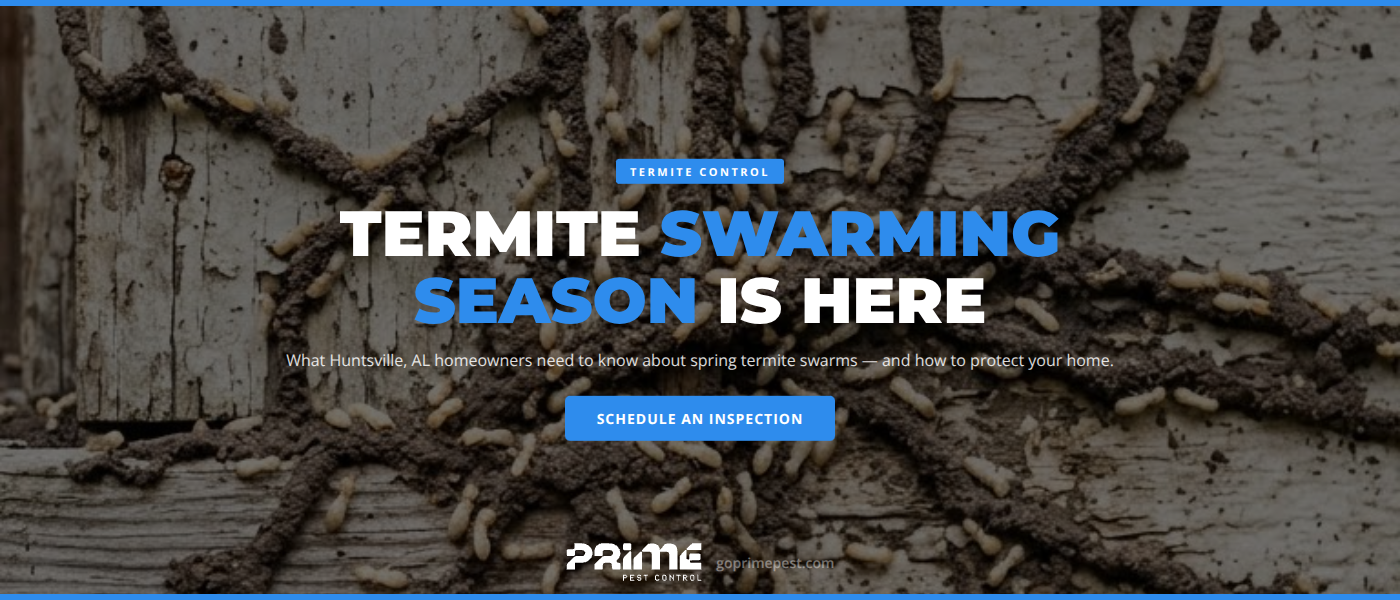
When spring arrives in Huntsville, AL, it brings warmer temperatures, blooming redbuds — and termite swarming season. Every year, as daytime highs climb past 70°F after a spring rain, subterranean termite colonies send thousands of winged reproductives into the air to find mates and start new colonies. For homeowners across the Huntsville area, this annual event is more than a nuisance. It signals that active termite colonies may be nearby — or already inside your walls. Understanding termite swarming season in Huntsville, AL is one of the most important steps you can take to protect your home.
Alabama ranks among the most termite-active states in the country. Our relatively mild winters rarely dip cold enough to suppress termite colonies, which means they stay active and feeding year-round. Spotting swarmers around your property does not automatically mean your home is infested — but it does mean a colony is close enough to send reproductive members your way.
In this guide, we cover how to identify termite swarmers, why homeowners here face elevated risk, what damage untreated colonies cause, and exactly what to do when you spot them this spring.
Termite swarming season is the period each year when mature colonies release their winged reproductive members — called alates or swarmers — to find mates and establish new colonies. This is not random. It is a biologically triggered process set off by a specific combination of warmth, moisture, and light.
In North Alabama, subterranean termite swarms typically begin in late February and peak from March through May. The dark southeastern subterranean termite, the most common species in our area, swarms during daylight hours after a rain event. Formosan termites — an invasive species spreading northward through Alabama — swarm at night during late spring and early summer, making them easier to miss.
A swarm usually lasts no more than 30 to 40 minutes. After emerging, swarmers drop their wings, pair up, and attempt to burrow into moist soil to begin a new colony. The winged insects you see are not the ones eating your home — they are the future founders of new colonies. But their presence tells you that an established, mature colony is already active nearby. Colonies typically take three to five years to reach swarming maturity — a swarm you see today represents years of established feeding activity.
Finding piles of discarded wings near windows, doors, or baseboards is one of the clearest signs that swarmers have emerged from inside your home. That discovery calls for a professional inspection without delay.
One of the most common questions we hear from Huntsville homeowners is whether they are looking at termite swarmers or flying ants. Both emerge in spring, and both have wings — but there are reliable ways to tell them apart.
Why does the distinction matter? Flying ants are a nuisance but do not damage wood. Termite swarmers indicate that a mature colony — one that has been feeding for years — is active on or near your property. If you find winged insects indoors, try to capture a few in a sealed bag. We can identify the species and determine whether a termite inspection is warranted.
Alabama's climate creates near-perfect conditions for subterranean termites, and the Huntsville area is no exception. Unlike homeowners in northern states who benefit from a genuine winter kill-off, we deal with termites that never fully go dormant. Our mild winters allow colonies to stay active and feeding throughout the colder months, building strength for the spring swarming surge.
The humidity that defines our summers also creates the moisture-rich soil subterranean termites need to survive. These termites build mud tubes to travel from underground nests to above-ground wood sources, and the clay-heavy soils throughout Madison County hold moisture exceptionally well — an advantage for the colonies, not for homeowners.
Adding to the concern is the northward spread of Formosan termites. This invasive species forms colonies far larger than native subterranean termites and feeds at a significantly faster rate. Their presence across North Alabama has been growing, and standard inspections and treatments must account for this more aggressive species.
The Alabama Cooperative Extension System recommends annual termite inspections for all homeowners in the state.
Termites work inside walls, floors, and structural beams without obvious surface signs for months or years. By the time visible damage appears, a colony may have already compromised the integrity of load-bearing wood — and repairs become significantly more complex.
Nationwide, termites damage approximately 600,000 homes every year, and property owners spend an estimated $5 billion annually on control and repairs. The average homeowner who discovers active termite damage spends around $3,000 on repairs — and that figure climbs sharply when structural beams, subflooring, or joists are involved.
Common warning signs of hidden termite damage include:
Standard homeowners insurance does not cover termite damage anywhere in Alabama. The financial exposure falls entirely on the property owner, which makes early detection and consistent prevention far more valuable than post-damage repairs.
Finding swarmers around your property requires a calm but prompt response. Here is what we recommend:
Do not spray them with a consumer pesticide. Aerosol sprays scatter the swarmers without addressing the colony below. You may eliminate the visible insects while the colony continues feeding undetected.
Collect a sample. If possible, capture a few insects in a sealed bag or container. Identification helps us determine the species and the right treatment approach.
Note where they emerged. Swarmers coming from inside the home — near baseboards, window frames, or crawl space access points — indicate the colony may be within the structure itself. Document what you observe and where.
Avoid disturbing the area. Hold off on digging near the foundation or applying mulch against the house until after an inspection is complete.
Call a professional promptly. At Prime Pest Control, our technicians are trained to assess the full extent of termite activity before recommending any course of action. We perform thorough inspections of the structure, foundation perimeter, and crawl space to identify where a colony is feeding and how far the damage has progressed.
Waiting is the costliest option. Termite colonies grow continuously, and a swarm dismissed this spring can represent thousands of dollars in structural damage by the following year.
When you contact us for a termite concern, we begin with a comprehensive inspection of your property — including the crawl space, attic framing, foundation perimeter, basement areas, and any attached structures such as garages or covered porches. Our goal is to identify not just active termite activity but also the conditions making your home attractive to future colonies.
Our termite treatment options include two primary approaches:
Liquid termiticide: Applied to the soil around and beneath the structure, this treatment creates a chemical barrier that termites transfer through contact and carry back to the colony, addressing the problem at its source.
Bait stations: Placed strategically around the perimeter, bait stations attract termites away from your home's wood. The bait is carried back to the colony, and over several weeks to months a well-placed system can eliminate an entire colony.
We review every finding with our clients before beginning any work. You will understand what we found, where the activity is, and why we recommend a specific approach. We serve Huntsville and surrounding areas including Madison, Harvest, Athens, and Meridianville.
The most effective termite treatment is the one you never need. While professional inspections are essential, there are meaningful steps homeowners can take year-round to reduce their risk.
Control moisture around your foundation. Fix leaky pipes and irrigation lines, clean gutters regularly, and make sure downspouts direct water at least six feet from the foundation. Standing water near the foundation creates ideal conditions for termite colonies.
Manage wood and mulch placement. Store firewood, lumber, and wood debris at least 20 feet from your home's exterior. In Alabama's humid climate, wood mulch stays moist — keep it at least six inches from your foundation and avoid piling it directly against siding or trim.
Eliminate wood-to-soil contact. Inspect deck posts, porch supports, and fence connections. Any point where wood meets soil is a potential entry route for subterranean termites. Use pressure-treated lumber for all ground-contact applications.
Seal foundation cracks and entry points. Inspect your foundation annually for cracks, and seal gaps around utility penetrations where pipes or wires enter the structure.
Schedule an annual termite inspection. Spring — before swarming season peaks — is the most effective time. Our team at Prime Pest Control can coordinate your termite inspection with your existing general pest control plan to keep your whole home protected. We also offer mosquito control and ant control services for complete perimeter protection through every season.
In Huntsville, termite swarming season typically begins in late February and peaks from March through May. Swarms are most likely to occur on warm, humid days following a rain event. Formosan termites — an increasingly common species in North Alabama — also swarm in late spring and early summer, typically at night.
Swarmers emerging from inside the home — near baseboards, window frames, or floor vents — strongly suggest that an active colony is present within the structure. Swarmers in the yard or flying in from outside are less conclusive but still warrant attention. A professional inspection is the only way to know for certain what you are dealing with.
The average homeowner who waits until visible termite damage appears spends around $3,000 on repairs — and that rises sharply if structural components are compromised. Professional treatment and annual inspections cost a fraction of that figure. Early action is almost always the more economical path.
Standard homeowners insurance does not cover termite damage in Alabama. Termite damage is classified as a preventable maintenance issue, placing full financial responsibility on the property owner — there is no insurance backstop if termites get ahead of you.
Termite swarming season in Huntsville, AL is your annual reminder that these insects are active, colonies are growing, and new ones are looking for a place to establish. The good news is that early action changes everything. Whether you spotted swarmers near your foundation this spring or simply want the peace of mind that comes from a professional inspection, our team is here to help. Contact Prime Pest Control to schedule your termite inspection today. With a 4.9-star rating from over 2,574 customers across the Huntsville service area, we are committed to protecting the homes in our community — one inspection at a time.