
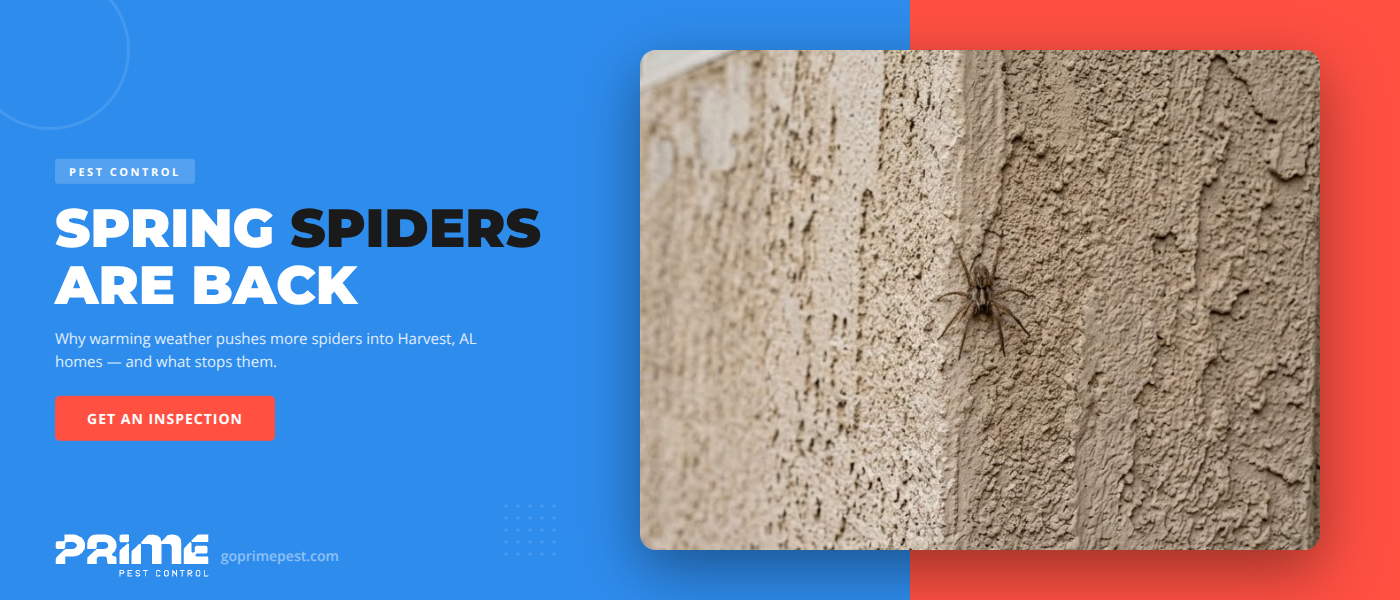
Every spring, homeowners across Harvest, AL notice the same uninvited guests: more spiders in the corners of garages, more webs across porch lights, and the occasional wolf spider darting across a basement floor. Spring spider activity is one of the most common calls our team fields between March and June, and it is rarely random. Warming temperatures, longer days, and an explosion of prey insects pull spiders out of dormancy and push them right up against — and into — our homes. Effective spider control in Harvest, AL starts with understanding why spring is such an active season and what to do before a few sightings turn into a steady indoor presence.
North Alabama's humid subtropical climate is part of why this happens here every year. Our mild winters never push spiders into a deep, statewide die-off, and our wet, warm springs supply exactly the conditions both spiders and their prey need to thrive. For Madison County homeowners, that means seasonal vigilance is more effective than reactive cleanups in midsummer.
Below, we walk through what drives spring spider activity, the species you are likely to see, where they hide, the warning signs of a larger problem, and why DIY sprays fall short.
Spiders are predators, and predator populations follow prey populations. As soil temperatures climb past the mid-50s and overnight lows stay above freezing, the insects that feed nearly every spider species in Harvest — small flies, gnats, mosquitoes, ants, beetles, and moths — start emerging in huge numbers. Spiders follow that food source. Web-building species set up on porches, eaves, and shutters where insects gather around exterior lights, and active hunters such as wolf spiders move through garages, sheds, and crawl spaces in search of the same meals.
Three local conditions amplify this in Madison County. Spring rainfall is heavy and frequent — March through May routinely deliver thunderstorms that saturate the ground and drive ground-dwelling insects up toward foundations. Mild winters mean Alabama spiders rarely die off; they slow down in cool months and ramp up the moment the weather breaks. And our humid air keeps moisture pockets — basements, crawl spaces, garages — attractive to both prey and predator long after the last frost. By April, our team is regularly inspecting Harvest properties where webs have appeared seemingly overnight and indoor sightings have crept up week over week.
Not every spider you see in spring is a cause for concern. Most are harmless and even helpful — a single common house spider can intercept dozens of nuisance insects in a week. Knowing which species you are dealing with helps you decide what level of response is warranted.
Two species deserve their own section because they carry medical risk.
Spiders are creatures of opportunity — they settle wherever prey is plentiful and disturbance is minimal. In a typical Harvest home, certain zones see most of the activity.
Outdoors, expect concentrations around exterior lighting, under eaves and roof overhangs, behind shutters, along window frames, around HVAC condensers, and in stacked firewood. Mulch beds against the foundation are particularly active in spring — they hold both moisture and the insects spiders eat.
Indoors, look for activity in undisturbed corners and storage areas: basement and crawl space corners, garage rafters and stored boxes, attic insulation gaps, behind appliances, under bathroom and laundry sinks, and inside rarely-opened closets. Cellar spiders favor cool, damp pockets. Wolf spiders patrol floors. Recluse-type spiders prefer dry, undisturbed clutter — boxes left in attics or closets for years are classic harboring sites.
Most homeowners can map their own activity zones in 15 minutes with a flashlight. Wherever webbing, egg sacs, or droppings concentrate is where prevention pays off most.
Seeing one or two spiders in spring is normal. Several signs suggest the population has crossed from incidental to established, and at that point most homeowners benefit from professional treatment.
If two or more of these apply, the underlying issue is usually not "more spiders" — it is the prey insect population that is feeding them. Treating both is what produces lasting relief.
The vast majority of spiders in North Alabama are harmless. Two are venomous and deserve immediate respect: the black widow and the brown recluse. The Alabama Cooperative Extension System publishes ID guidance on both, and we recommend every homeowner familiarize themselves with the markings.
Black widow. Glossy black, rounded body roughly the size of a large pea, with a distinctive red hourglass-shaped marking on the underside of the abdomen. Females are the species of medical concern; males are smaller and rarely bite. Black widows favor dark, undisturbed outdoor spaces — woodpiles, crawl space corners, garages, sheds, and under porch furniture that has not been moved in months. Bites are uncommon but require prompt medical evaluation.
Brown recluse. Light to medium brown, about the size of a quarter including legs, with a violin-shaped marking on the head and thorax. The most reliable identifier is the eyes: recluses have six eyes arranged in three pairs, while most other spiders have eight. They prefer warm, dry, undisturbed indoor spaces — attics, closets, storage boxes, and behind furniture that does not move. Most bites occur when the spider is pressed against skin in stored bedding, shoes, or clothing, and they can produce serious tissue reactions. Seek medical evaluation without delay.
If you find either species — or a spider you suspect might be either — do not handle it. Photograph it from a careful distance and contact a professional. Identification is one of the first things our technicians help with on a service visit.
Most homeowners who call us after a season of DIY treatments share a similar experience: the spray killed what it touched, but the spiders kept coming back. There are a few reasons the over-the-counter approach falls short for North Alabama properties.
Contact-only sprays do not address the food source. Consumer-grade products rarely reduce the prey population drawing spiders in. New spiders simply move in to replace the ones eliminated.
Hidden harborage stays hidden. Spiders nest in places most homeowners cannot easily reach — attic eaves, soffit voids, crawl space corners, behind weep holes in brick veneer. A perimeter spray on the patio does not penetrate those zones.
Webs and egg sacs survive. Egg sacs are built to protect developing eggs, and consumer products rarely have the residual effect needed to disrupt the next generation.
The pattern we see most often is a homeowner spending more on rotating products through spring and summer than they would on a professional plan that addresses the root cause once.
Our approach to spider control is built around two ideas: knock down the existing population, and reduce the conditions that brought them in. That is what produces results that hold through spring and summer instead of bouncing back two weeks after a one-off spray.
A typical service visit for a Harvest home includes:
For homeowners dealing with confirmed black widow or brown recluse activity, we adjust the protocol — spending additional inspection time in attics, closets, basements, garage corners, and storage areas, and providing identification support so you can be confident about what is in your home.
Spring brings a surge of insect activity in Madison County — small flies, gnats, mosquitoes, ants, and moths emerge in large numbers as the ground warms. Spiders follow that food source. Web-building species concentrate around exterior lights, eaves, and porches, while hunting species like wolf spiders move into garages, basements, and crawl spaces.
No. The large majority of spiders you encounter in and around Harvest homes — common house spiders, cellar spiders, wolf spiders, orb weavers, jumping spiders — are harmless and actually help control nuisance insects. Two species in North Alabama, the black widow and the brown recluse, carry medical risk and should never be handled. If you suspect either species, photograph the spider from a distance and have a professional confirm the ID.
Three steps make the biggest difference: reduce the prey insects that draw spiders in (a year-round pest control plan does most of this work), seal entry points around windows, doors, utility penetrations, and foundation cracks, and limit harborage by clearing clutter from garages, basements, and storage areas. Switching exterior lighting to amber or yellow LEDs also reduces the insect — and therefore spider — activity around doorways.
If you are seeing webs reappear within days of cleaning, multiple egg sacs around the property, repeated indoor sightings in living areas, or any spider you suspect could be a black widow or brown recluse, it is time for a professional inspection. Spring is the most effective time of year to address spider activity — treating early, before populations peak, is far easier than chasing them through summer.
Spring spider activity is a normal part of life in Harvest, AL, but it does not have to mean a season of webs across every doorframe. With early intervention, prey-insect reduction, and a plan tuned to North Alabama conditions, your home can stay clear through summer. Contact Prime Pest Control to schedule a spider inspection for your Harvest property. With a 4.9-star rating from more than 2,574 customers across the Huntsville and Madison County area, we are committed to protecting the homes in our community — one inspection at a time.