
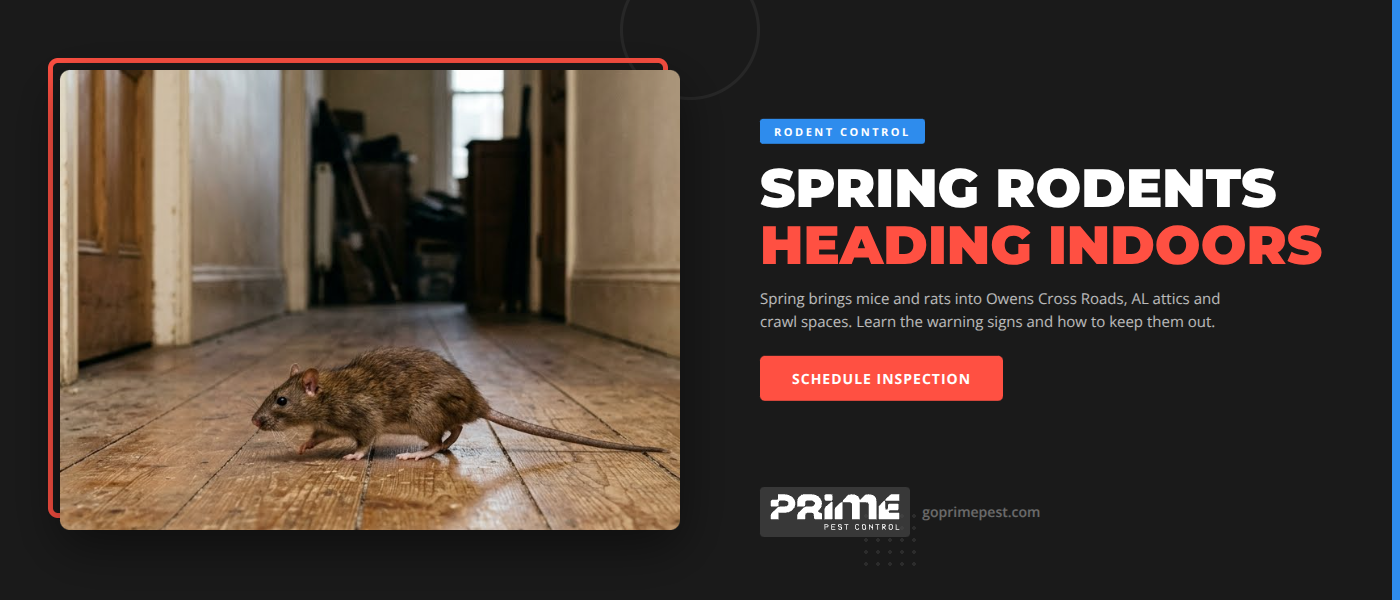
Most Owens Cross Roads, AL homeowners think of mice and rats as a fall-and-winter problem — and they are not wrong, exactly. Cold weather does push rodents indoors. But the call volume we field at Prime Pest Control tells a different story about spring. Once the weather warms up across Madison County, a brand-new wave of rodent activity moves into attics and crawl spaces, and homeowners are caught off guard because they assumed the threat had passed.
Spring rodent issues look different from winter ones, and they almost always involve hidden spaces — attics, crawl spaces, soffits, garages, and wall voids — rather than the kitchen pantry. Below is what we see on Owens Cross Roads properties from late March through June, why it happens, and how we recommend handling it before a small intrusion becomes a full infestation.
The driver is reproduction, not temperature. House mice and rats hit their first major breeding peak of the year in early spring. A pregnant female mouse needs a quiet, sheltered, climate-stable space to build a nest — and the attic of an Owens Cross Roads home, with its dark corners, fiberglass insulation, and steady spring temperatures, is closer to ideal than anything in the surrounding woods or fields.
Spring rains around the Flint River and the Tennessee Valley also push rodents up and out of low-lying burrows. Saturated soil collapses Norway rat tunnels along creek banks and ditches, and the displaced rats relocate to the nearest dry, elevated structure — usually a crawl space, garage, or shed. Add new construction expanding into wooded areas off Old Highway 431, Sutton Road, and Hampton Cove, and a lot of rodent populations are losing habitat at exactly the moment they are looking for a place to nest. Homes become the most attractive option within their range.
Three species cause nearly every rodent call we run in Owens Cross Roads and the broader Huntsville area. Each one favors different parts of the house, which matters because the inspection and exclusion work changes accordingly.
Knowing which species is present changes the trap layout, the bait selection, and where we focus the exclusion work. A roof rat treatment that ignores the soffits will fail; a Norway rat treatment that does not address the crawl-space perimeter will fail. The ID has to come first.
Spring rodent activity is usually overhead or underneath the living space, not inside it, which is why so many infestations go unnoticed until the population is well established. Some signs are worth investigating right away:
One sign on its own warrants a closer look. Two or more, and active rodents are almost certainly present.
Rodents are not a cosmetic nuisance — they are a measurable risk to both health and the structure of the home. According to the Centers for Disease Control and Prevention, rats and mice are known to spread more than 35 diseases, several of which are present in the southeastern United States, and exposure can occur from droppings, urine, saliva, or contaminated nesting material — not only from direct contact with a live rodent.
The property damage is just as real. Insulation contaminated with urine and droppings loses R-value and has to be removed and replaced. Chewed electrical wiring is implicated in a meaningful share of structure fires nationally each year. HVAC duct breaches cost conditioned air, raise utility bills, and pull insulation fibers and rodent contaminants into the air handler. In crawl spaces, torn vapor barriers allow moisture into the subfloor, which then attracts wood-destroying pests on top of the rodent problem.
The longer a rodent population stays, the broader the damage radius becomes — and the higher the eventual repair bill. Spring is the cheapest possible moment to intervene because the population is still small.
Exclusion — sealing the openings rodents use to get in — is the only long-term solution. Trapping or baiting without exclusion just creates a vacancy for the next rodent to fill. On Owens Cross Roads homes, here is where we focus the work:
Steel wool packed into a hole and sealed with a polymer sealant is a reasonable short-term patch on small openings, but anything larger than a pencil needs hardware cloth or sheet metal. Spray foam alone does not stop a determined rodent.
Snap traps work — for the individual rodent caught in them. The problem is that snap traps do not address reproduction rates, do not seal entry points, and do not reach the colony nesting in the attic or under the bath trap. A single female mouse trapped at the back of the pantry while five more are nesting above the bedroom ceiling is not a solved infestation.
Glue boards have the same limitation and add a humane concern most homeowners are not comfortable with after the fact. Over-the-counter rodenticide pellets create a different problem: the rodent eats, then dies in a wall void or attic where the carcass is unreachable, and the resulting odor and secondary pest issue can last weeks.
Effective rodent control combines four elements: accurate species ID, full structural exclusion, strategic trapping or baiting at the right life-cycle moment, and a follow-up visit to confirm the population is gone. Skipping any one of the four is the most common reason DIY efforts fail and the same rodents return within a season.
Our rodent service is built around exclusion, not just removal. On the first visit, our technician inspects the attic, crawl space, exterior perimeter, roofline, and outbuildings, documents every active entry point with photographs, and identifies the species based on droppings, gnaw marks, and travel evidence. From there we deliver a written exclusion proposal that lists every opening that needs to be sealed and the material we will use for each.
Trapping or targeted baiting runs in parallel with the exclusion work. We use tamper-resistant exterior bait stations placed away from the home's foot traffic and pet zones, and interior snap-trap arrays inside the attic or crawl space where activity is documented. Follow-up visits confirm the catches and the absence of fresh sign before we close the service out.
Our rodent control service can also be paired with our general pest control program so the home is covered against the secondary insect issues that often follow a rodent problem — the mites, dermestid beetles, and flies that move into contaminated insulation or unreachable carcasses if the cleanup is incomplete.
Possibly. Squirrels are active in the attic in early morning and late afternoon, not the middle of the night. Raccoons make heavier, more distinct movement and usually only enter through a clearly visible roof breach. Steady scratching after dark and before dawn is almost always rodents — mice if the sound is light and quick, rats if it is heavier and slower.
Spring is the breeding peak. Winter pushes rodents indoors looking for warmth; spring brings them in to nest and reproduce. The infestations we treat in late spring are often larger and more established than the winter ones because they have had a full breeding cycle to grow.
The initial inspection and trap placement is usually a single visit of one to two hours. Exclusion work — sealing all the entry points — can range from a half day to two days depending on the home's age, crawl-space condition, and the number of openings. Follow-up trap checks run over the next two to four weeks until we confirm the population is gone.
All three species we commonly find here — house mice, roof rats, and Norway rats — can carry pathogens transmissible through droppings, urine, and contaminated nesting material. The CDC documents rodent-related concerns including hantavirus, leptospirosis, and salmonellosis. None of these are common in any individual home, but the risk is real enough that contaminated insulation and nesting material should be removed by someone with proper protective equipment, not handled with bare hands.
You can reduce future entry significantly with thorough exclusion, and we encourage homeowners to do what they can on the easy openings. But locating every opening on a typical Owens Cross Roads home is harder than it looks — we routinely find ten to twenty active entry points on an inspection where the homeowner had already identified two or three. Combining your exclusion work with a professional inspection is a reasonable middle ground.
Spring is the moment to get ahead of a rodent problem in Owens Cross Roads, before a small nest in the attic becomes a multi-generation infestation by July. If you have heard scratching overhead, found droppings in the garage, or noticed disturbed insulation in the crawl space, get in touch with Prime Pest Control and we will inspect, identify, and put together an exclusion plan specific to your home.