
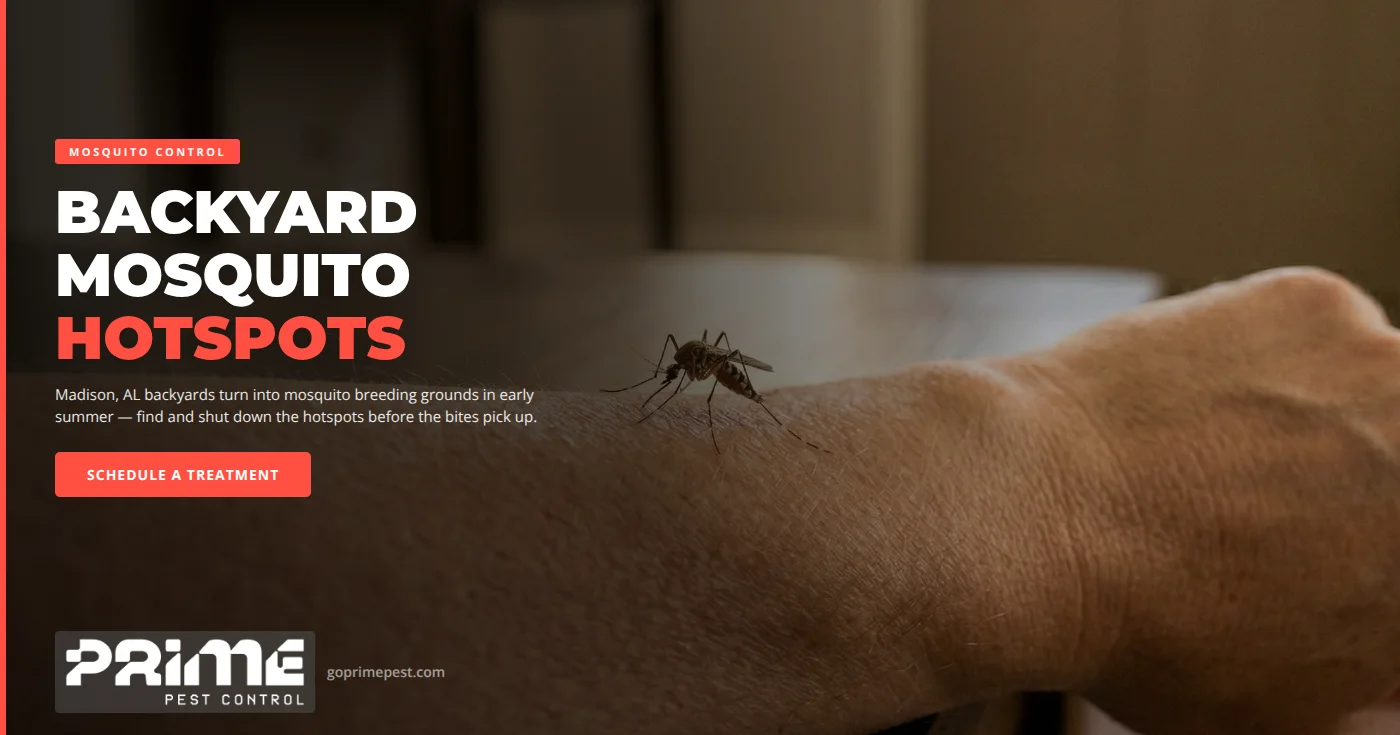
By the second week of June, porches and patios across Madison, AL go from quiet evening retreats to mosquito ambush zones almost overnight. Spring rain banks moisture in the soil, summer humidity climbs, and the same backyards that looked fine in May start humming with biters the week school lets out. Once that tips over, mosquito control in Madison AL stops being a seasonal question and becomes a weekly one for most homeowners.
This guide is the field-level walk-through our technicians use on Madison properties — where mosquitoes actually breed, the hotspots almost every homeowner misses, the disease picture in our part of the state, and how Prime Pest Control treats Madison yards through the full mosquito season.
Madison sits squarely in a humid subtropical climate where summers are long, hot, and muggy. By June, average relative humidity in town hovers around 75%, daytime highs push into the upper 80s, and roughly 1.9 inches of rain falls across about 15 wet days. That combination — warm air holding more moisture, frequent afternoon thunderstorms, and standing water that does not evaporate before nightfall — is the exact setup the mosquito life cycle needs to accelerate.
Most species we deal with in North Alabama can move from egg to biting adult in 7 to 10 days when conditions are warm. Drop temperatures 15 degrees and the cycle doubles. Hit a sustained run of 85 to 90°F afternoons with high humidity, and you can stack two or three new generations in a single month. That is why our Madison service calls rarely tick up in early May, then explode the week after the first stretch of 90°F afternoons.
Wind matters too. Evening breezes around Town Madison and Bradford Creek are often blocked by mature tree canopy and dense fence lines, and the calm pockets at sunset are exactly where adult mosquitoes feed. That geometry shapes our hotspot mapping more than most homeowners realize.
We start every mosquito program with a property walk-through, and the hotspots we flag are remarkably consistent from one Madison yard to the next. The list almost never changes:
None of these need to look obviously wet to be a problem. Mosquitoes only need a bottle cap of water to lay eggs, and many species pushing pressure in North Alabama — including the aggressive Asian tiger mosquito that bites all day — prefer artificial containers and shaded depressions over open ponds.
This is where most do-it-yourself plans break down. Homeowners look for "puddles," but the real breeding pressure comes from spots that hold an inch of water silently for days.
Clogged gutters. A roof full of pin oaks and sweet gums sheds leaves into Madison gutters every spring storm. Once leaf matter dams the downspouts, the gutter trough holds a shallow band of water along the entire roofline. From the ground you cannot see it. From a ladder, you see hundreds of larvae wiggling at once. Clear gutters at least twice a year — and more often if you have mature hardwoods overhanging the house.
Water-holding ornamental plants. Bromeliads, ornamental bananas, and some elephant ear varieties cup water in their leaf bases. We flush these with a hose every few days during peak season, or recommend a granular larvicide labeled for ornamentals when the planting is dense.
Kids' toys and pet bowls. Sandbox toys left right-side-up after a thunderstorm. Kiddie pools you meant to empty on Monday. The bottom dish of a planter. A slow-leak garden hose end. Outdoor dog and cat water bowls. Every one of those is a viable nursery. We tell families with young kids to walk the yard for two minutes every Saturday morning and dump anything holding water.
Tarps, trash cans, and bird baths. Folds in a grill or pool cover hold pints of water. Garbage cans without lids fill during storms. Bird baths need to be flushed and refilled twice a week, not topped off. Rain barrels need a mesh screen over the inlet and a Bti dunk inside whenever water is held longer than a week.
The leafy, mature neighborhoods that make Madison so livable are the ones we get the heaviest mosquito calls from. Tree canopy traps humidity, blocks UV that would otherwise dry exposed surfaces, and gives adult mosquitoes the cool, shaded resting spots they need between feedings.
When we treat a yard, the heaviest barrier application goes to the underside of leaves, the lower trunks of shade trees, fence lines, and dense ornamental beds — not the open lawn. Spraying open turf is mostly wasted product because adult mosquitoes are not resting there during the day. They are tucked into the cool 12-to-36-inch zone where humidity stays highest and direct sun never reaches.
Landscaping choices that quietly amplify the problem in Madison yards include English ivy along a foundation, dense pittosporum or holly hedges, monkey grass borders that hold dew until midday, and any spot where weed fabric and mulch have collapsed into a saucer that holds water. None of these need to come out — they just need to be on our treatment map.
Most mosquito bites in Madison are an itchy nuisance, not a health emergency. But the disease risk is real enough that the Alabama Department of Public Health tracks it every year. Two mosquito-borne viruses matter most in our part of the state.
West Nile Virus (WNV). This is the more common of the two in Alabama. About 80% of people infected never develop symptoms; roughly one in five develop a fever, headache, body aches, and sometimes a rash. A small percentage develop neuroinvasive disease. Alabama counties confirmed multiple human cases during the 2025 season, and ADPH expects similar pressure heading into summer 2026.
Eastern Equine Encephalitis (EEE). Less common but far more serious. EEE is rare in humans, but the case fatality rate is high and there is no specific antiviral treatment. Horses are at especially high risk — the Alabama Department of Agriculture & Industries urges North Alabama horse owners to keep EEE and WNV vaccinations current every six months.
The practical takeaways from the CDC and ADPH stay consistent for Madison families: use an EPA-registered repellent containing DEET, picaridin, or oil of lemon eucalyptus outdoors at dusk; wear long sleeves and pants during peak biting hours; install or repair window screens; and — most importantly — eliminate standing water around the home. Reducing breeding sites at the property level is still the highest-impact thing a homeowner can do to lower local virus pressure.
DIY mosquito control has a real role. Sanitation — dumping containers, cleaning gutters, fixing drainage — is the foundation of every program we run, and no amount of professional spraying overcomes a yard with five untreated breeding sites.
Where DIY hits its ceiling is in adult control and residual barrier treatment. A hardware store fogger kills the mosquitoes flying at that moment and very few of the ones that hatch the next morning. Citronella candles knock down odor more than mosquitoes. Bug zappers kill mostly beneficial insects. Handheld backpack sprayers rarely reach the underside of leaves and shaded trunks where adult mosquitoes actually rest during the day.
A professional barrier treatment is built around three things DIY cannot easily match:
That is the combination that takes a Madison yard from "we cannot sit outside" to "we forgot the bug spray and never noticed."
Our mosquito control program in Madison is built for the way mosquito pressure actually behaves in North Alabama — a slow build in April, a steep ramp in June, sustained peak through August, and a long tail into October most years.
Here is what a typical season looks like with us on the property:
We focus exclusively on Madison, Huntsville, Harvest, Hampton Cove, Owens Cross Roads, and the surrounding North Alabama service area. Our technicians know the local pressure, vegetation, and hotspots better than a national-chain crew — and that local read is what makes consistent mosquito control in Madison AL possible across a full summer.
Activity usually picks up in April and ramps fast through June. Peak biting pressure runs from late June through September, with a long tail into October most years. We recommend starting monthly barrier treatments by mid-April to get ahead of the first big hatch.
In Madison's summer heat, eggs in standing water complete the larval stage in 7 to 10 days. Walk the property every Saturday during peak season and dump anything holding water — one missed week is enough for a new generation.
Our barrier treatments are applied to harborage zones — under leaves, fence lines, shaded beds — not open blooms, and we apply at times of day when pollinators are less active. We are happy to walk through the exact products and timing during your inspection so there are no surprises.
A standard barrier treatment knocks down tick populations along fence lines and shaded ground cover as a secondary benefit. If ticks are your primary concern, we can adjust the protocol and add specific tick-targeted applications.
We usually schedule an initial inspection within one to three business days, and the first barrier treatment typically goes down at the inspection or the next visit.
Madison mosquitoes are not going to thin out on their own this summer — the climate, the canopy, and the rain pattern guarantee that. The yards that stay usable through July and August are the ones where breeding sites are eliminated and a professional barrier keeps up with each new generation. If you are tired of giving up your evenings on the patio, get in touch with our mosquito control team and we will map your property and get you on a treatment schedule before the next big hatch.